01. The Political Funnel: Are Our Choices Too Limited?

In many representative democracies, citizens are invited to participate in politics through a process that is both important and constrained. At election time, voters choose between candidates and parties. Those choices matter: governments can change, policies can shift and public accountability can be exercised. Yet the range of choices on the ballot is usually shaped long before voters arrive at the polling station.
Political parties select candidates, establish manifestos and organise debate around competing programmes. Electoral systems then translate votes into representation in particular ways. Media coverage, campaign finance, party structures and the practical demands of governing all influence which ideas receive attention. A voter may therefore be choosing between available options without having had much opportunity to shape the options themselves.
This is the political funnel: a wide and diverse public, with many experiences and ideas, passes through a narrower set of institutions and choices. The funnel is not necessarily evidence of bad faith. Large societies need ways to make decisions, organise disagreement and select representatives. The question is whether the process filters out too many useful ideas or leaves too many people feeling that participation begins and ends with choosing a party.
The challenge is not to dismiss representative democracy or the freedoms it has helped protect. It is to ask what could complement it. Could citizens help set priorities between elections? Could independent deliberative forums examine difficult questions? Could people propose ideas, scrutinise evidence and receive reasoned responses from institutions? A healthy democracy should be capable of learning and adapting.
The starting question is simple: are citizens being offered meaningful choices about the direction of society, or mainly a choice between political teams? If the answer is partly the latter, how might we widen the conversation without weakening rights, accountability or democratic safeguards?
02. Beyond Left and Right: Can We Move from Political Division to Shared Problem-Solving?

Political labels can help people understand broad traditions, but they can also turn complex questions into team identities. Left and right are often treated as fixed camps, even though people may hold combinations of views that do not fit neatly into either category. Someone might support strong public services, small businesses, civil liberties, environmental protection, local decision-making and strict limits on concentrated power. Which political box contains all of that?
The labels also encourage debate to become a contest over identity. Once a policy is associated with a political tribe, people may judge it by who proposed it rather than by the evidence, its likely consequences or the values it serves. This makes it harder to learn from approaches that originate outside one's preferred tradition.
Moving beyond left and right does not mean pretending that ideological differences are unimportant. Questions about ownership, taxation, markets, equality, individual freedom and the role of the state involve real trade-offs. Nor does shared problem-solving mean everyone must agree. It means creating conditions in which disagreement can be examined constructively.
A practical alternative is to begin with the problem and the outcomes people want to achieve. What evidence describes the situation? Who is affected? What options exist? What are the likely costs, benefits and unintended consequences? How would success be measured, and how could a policy be changed if it failed? Different political traditions may contribute useful answers to different parts of the same problem.
The Forum's purpose is not to replace one ideology with another. It is to create a space where ideas can be compared on their merits and where people can challenge assumptions without being reduced to political labels. The question becomes less about which side wins and more about whether society becomes fairer, freer, healthier, more capable and more sustainable.
03. Looking Ahead: Where Is the Current Trajectory Taking Us?

Societies are shaped by millions of decisions, but their combined direction is not always consciously chosen. Economic incentives, technology, demographic change, geopolitics, environmental pressures and institutional habits interact. The result can feel like a trajectory: a path that continues because existing systems, investments and expectations make alternatives difficult to imagine or implement.
Some trends offer extraordinary possibilities. Scientific research, digital communication, renewable energy, medical advances and artificial intelligence could expand human capabilities. At the same time, these developments raise questions about ownership, access, privacy, employment, power and the distribution of benefits. Progress in technology does not automatically translate into progress in human wellbeing.
The future is not a single forecast waiting to happen. It is a range of possibilities shaped by choices, shocks and feedback. Scenarios can help us ask what might happen if current trends continue, if policies change or if unexpected events alter the conditions. They should be treated as tools for thinking, not predictions with guaranteed outcomes.
A useful exercise is to look beyond the next election or business cycle. What might today's decisions mean for children, future workers, public institutions, ecosystems and people not yet born? Are we building resilience, or accumulating risks that will be harder to manage later? Are the gains from innovation broadly shared, or concentrated among those who already possess capital and influence?
The Forum invites readers to examine the direction of travel rather than accept it as inevitable. We cannot know every detail of the future, but we can identify risks, compare possible paths and create institutions that help societies respond intelligently. The future will be influenced by what we choose to measure, reward, protect and prioritise today.
04. Are We Mistaking Familiar Systems for the Best Systems?

The institutions that organise daily life often become so familiar that they appear natural. Markets, states, banks, schools, political parties, property rules and employment arrangements are treated as the background of society rather than as systems created and revised by people over time.
Familiarity can be useful. Established systems hold accumulated knowledge, routines and safeguards. They can provide stability and make cooperation possible at scale. But familiarity is not proof of optimality. A system may persist because it works well for some groups, because alternatives are difficult to coordinate, because its rules are embedded in law and infrastructure, or simply because people struggle to imagine something different.
Every system involves design choices: who can participate, who owns assets, how decisions are made, how risks are shared, what behaviour is rewarded and how mistakes are corrected. Those choices can be examined. We can compare different models of public services, business ownership, local government, education, finance and democratic participation without assuming that one arrangement must work everywhere.
The question is not whether we can design a perfect system. Human societies are too diverse and circumstances change too quickly for a final blueprint. The more realistic aim is to build systems that can learn: transparent rules, meaningful accountability, reliable evidence, room for experimentation and ways to revise policies when outcomes disappoint.
We should neither romanticise the past nor assume that every new proposal is an improvement. The test is practical and ethical: does an arrangement protect rights, meet needs, distribute opportunity fairly, support innovation, limit abuses of power and remain adaptable? If we never ask whether familiar systems could be better, we risk confusing continuity with success.
05. The Nordic Countries: A Starting Point, Not the Destination
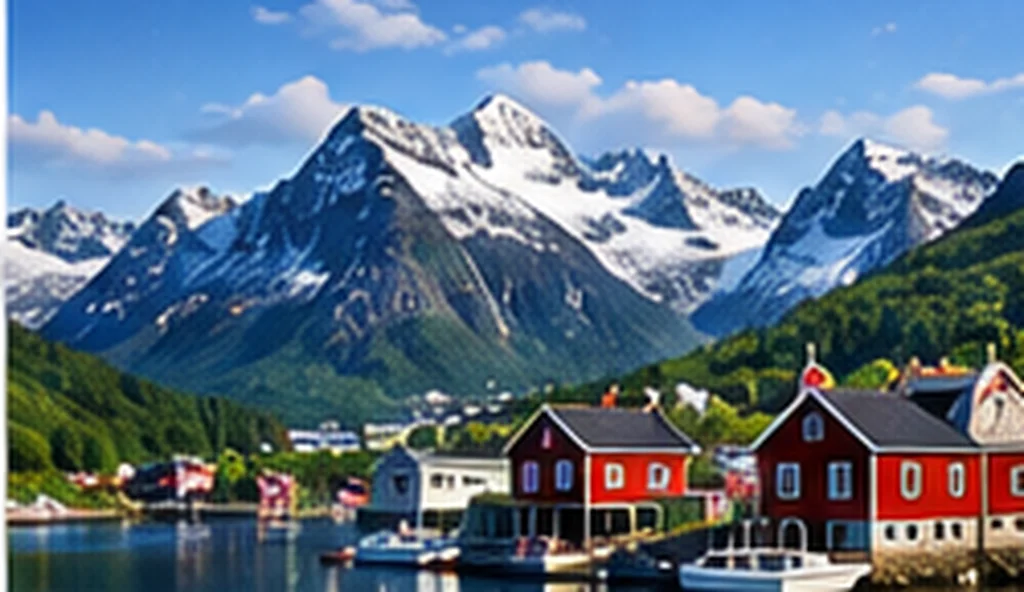
The Nordic countries are often discussed in debates about social democracy, public services, taxation, labour relations and quality of life. Denmark, Finland, Iceland, Norway and Sweden have developed distinct institutions, and they should not be treated as one identical model. Nevertheless, their experiences offer useful material for comparison.
Common features include relatively extensive welfare systems, broad access to public services, high levels of institutional trust in many measures, organised labour-market arrangements and market economies with substantial private enterprise. These countries combine public provision and regulation with businesses, trade and international competition. Their experience challenges the idea that economic dynamism and social protection must always be opposites.
But context matters. Population size, natural resources, historical development, social institutions, political culture, geography and global economic conditions all influence what can be transferred elsewhere. The Nordic countries also face challenges, including integration, demographic pressures, housing affordability, productivity, public-service capacity and debates about taxation and sustainability.
The point is not to copy a country wholesale or present it as a finished destination. It is to investigate particular policies and institutions: what problem were they designed to address, how are they funded, what outcomes have been measured, who benefits, what trade-offs exist and under what conditions might they work elsewhere?
A serious discussion of human flourishing should compare many examples, including successes and failures beyond Europe. The Nordic experience is one valuable reference point among many. It can widen the imagination, but it cannot substitute for careful analysis of local needs, democratic consent and practical constraints.
06. We Have the Capability. So Why Aren’t We Exploring?

Humanity has developed extraordinary scientific, technical and organisational capabilities. We can communicate across continents, model complex systems, sequence genomes, build advanced materials, coordinate global supply chains and analyse enormous quantities of information. Yet our ability to solve shared problems often appears fragmented.
Part of the explanation is that capability is not the same as coordination. Knowledge may be distributed across institutions that have different incentives, budgets and responsibilities. Governments face electoral cycles; businesses respond to market conditions; researchers compete for funding; communities have immediate needs. Each actor may behave rationally within its own environment while the combined result falls short of what society could achieve.
There are also genuine disagreements about values and priorities. People differ over freedom, equality, risk, tradition, growth, environmental protection and the proper role of institutions. Those differences cannot simply be engineered away. But they can be made more productive through transparent evidence, fair procedures and opportunities to test alternatives.
The question is whether we have built enough infrastructure for collective learning. Do citizens have accessible ways to contribute? Can public institutions compare policy experiments? Are research findings communicated clearly? Can communities test local solutions and share what they learn? Are there mechanisms for scaling successful approaches while stopping those that fail?
We do not need one central authority directing every aspect of society. We need better ways to connect knowledge, experience and decision-making. The capacity to explore alternatives already exists in many places. The challenge is to make that exploration more systematic, inclusive and accountable.
07. The Power of Information: Who Controls What We Know?

Information is essential to meaningful participation. People cannot evaluate decisions, challenge claims or contribute ideas if relevant knowledge is inaccessible, misleading or presented without context. Yet access to information has never been evenly distributed.
The printing press transformed the circulation of ideas in Europe from the fifteenth century onwards, although literacy, censorship, cost and political power continued to shape access. Later, newspapers, radio and television expanded public communication while giving publishers and broadcasters substantial influence over what reached mass audiences. The internet lowered many barriers to publication, allowing individuals and communities to communicate directly across borders.
Digital platforms have created new opportunities and new concentrations of influence. Search rankings, recommendation systems, advertising models, moderation rules and platform ownership can affect which material people encounter. These systems are complex and are not controlled by one actor alone. Their effects vary, and claims about algorithmic influence should be supported by evidence rather than assumed.
Artificial intelligence adds another layer. AI systems can help people search, translate, summarise and analyse information, but their outputs can also contain errors, reflect limitations in training data or present uncertain claims with confidence. Access to computing power, data and advanced models may become an important source of economic and political influence.
A flourishing society needs more than a large volume of information. It needs media literacy, independent journalism, transparent institutions, open research where appropriate, privacy protections and the ability to question powerful information intermediaries. The goal is not to control what people think. It is to help people assess evidence and make informed judgements for themselves.
08. Rethinking the Global Financial System

Money and finance are not separate from everyday life. They influence which businesses can grow, which homes people can afford, how governments fund services, how risks are shared and where investment flows. The global financial system connects households, banks, companies, investors, central banks and governments across borders.
Modern money creation is more complex than the simple idea that banks merely lend out deposits previously saved by someone else. Commercial banks create deposits when they make loans, subject to capital, liquidity, regulation, credit demand, profitability and monetary conditions. Central banks influence the system through interest rates, asset operations, regulation and their role in settlement. Governments also shape financial conditions through fiscal policy and public debt issuance.
Government borrowing can fund infrastructure, public services and responses to crises, but it also creates obligations and exposes public finances to interest costs and changing market conditions. Government bonds are held by a variety of investors, including pension funds, insurers, banks, central banks, investment funds and individuals. It is inaccurate to imply that all public debt interest simply flows to one type of private institution.
The wider questions concern purpose and accountability. Does finance channel capital towards productive activity and long-term resilience? Are households protected from abusive lending? Are systemic risks understood and managed? Do tax rules and financial regulation support fair competition? How can financial innovation serve the real economy rather than amplify instability?
There is no single reform that resolves these questions. Proposals such as public investment banks, cooperative finance, stronger consumer protection, transparent tax systems and better international coordination each have different strengths and risks. They deserve careful comparison. The aim should be a financial system that supports human wellbeing, productive investment and economic stability while remaining accountable to the public interest.
09. The Democratic Participation Gap: What Does Low Turnout Tell Us?
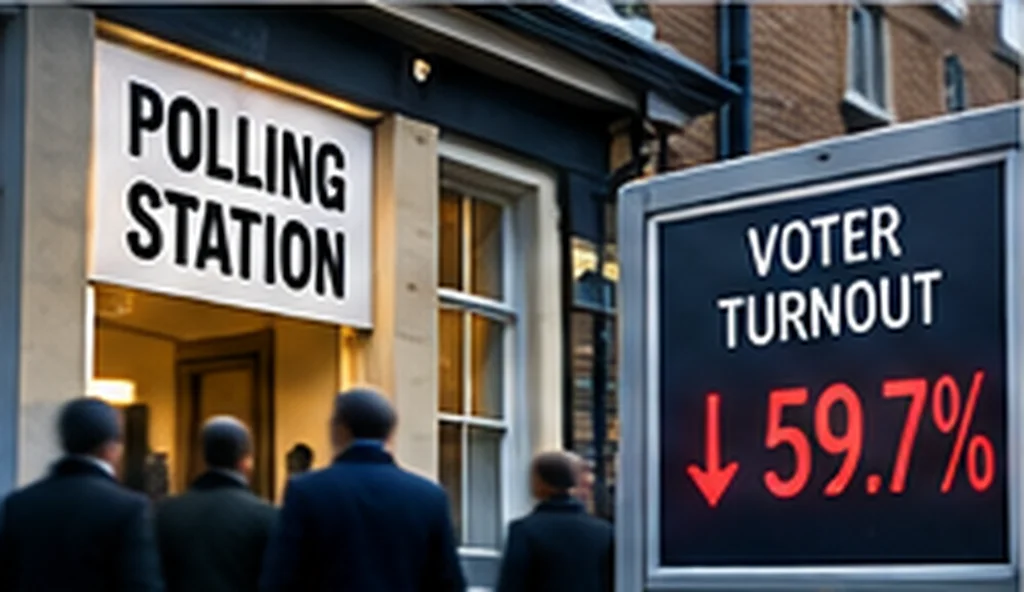
Voting is a central democratic right, but turnout is only one measure of participation. In the United Kingdom's 2024 general election, turnout was approximately 59.7 per cent of the registered electorate, the lowest at a UK general election since 2001 according to the House of Commons Library. That figure deserves attention, but it does not explain by itself why people did not vote.
Non-voting can have many causes: disillusionment, lack of trust, dissatisfaction with available choices, practical barriers, registration issues, illness, work commitments, political disengagement or a belief that one's vote will not change the result. Some people are deeply engaged in community life but do not participate in elections. Others vote consistently but have little involvement between elections.
It would be wrong to assume that every person who abstains is rejecting democracy or endorsing a particular alternative. The reasons need to be investigated through reliable surveys, local engagement and careful analysis. Turnout also varies by age, income, education, geography and election type, so averages can conceal important differences.
The deeper issue is whether people feel they can influence decisions that affect their lives. Elections provide a vital mechanism for choosing representatives and removing governments. But participation can also include citizens' assemblies, consultations, local budgeting, petitions, community organising, public scrutiny and direct engagement with elected representatives.
A stronger democracy should lower barriers to participation and show people what happens after they contribute. Consultation without feedback can deepen cynicism. Participation becomes meaningful when institutions explain what they heard, what they changed, what they did not change and why. The question is not simply how to persuade more people to vote, but how to make democratic influence more continuous and credible.
10. What If the Ballot Paper Offered Another Choice?

Imagine a ballot paper that included an additional option: “None of the above — I want a different political direction.” What would that option mean, and could it improve democratic expression?
In many elections, voters who dislike all available candidates or party programmes must still choose the option they consider least objectionable, spoil their ballot or abstain. A formal none-of-the-above option could make dissatisfaction more visible and measurable. It might signal that the available choices do not adequately represent a portion of the electorate.
But the details would matter enormously. Would the option be symbolic, or would it have legal consequences? If it received the most votes, would the election be rerun? Would parties be required to offer new candidates? How many times could a rerun occur? What would happen if voters rejected every available option again? Could the mechanism be abused by campaigns seeking to disrupt elections?
There are also alternative ways to widen choice: electoral reform, open primaries, citizens' initiatives, stronger local democracy, deliberative assemblies and more accessible routes for independent candidates. Each has different implications for representation, stability, accountability and the influence of money.
The purpose of raising this idea is not to claim that one additional box would solve democratic dissatisfaction. It is to ask whether the design of elections gives citizens enough ways to express their preferences. Any reform should be tested against clear principles: fairness, clarity, constitutional compatibility, equal voting rights and the ability to form stable, accountable governments.
11. The Round Table: Human, Artificial and Other Perspectives

Imagine a round table bringing together people with very different experiences: a parent, a scientist, a small-business owner, a care worker, a farmer, a teacher, a young person, an older citizen, a policymaker and someone whose life is shaped by decisions made far away. Add an artificial intelligence system as a research assistant, and imagine an external or unfamiliar perspective as a thought experiment. What might the conversation reveal?
The round table is a method for widening the questions we ask. People experience systems differently. A policy that looks efficient in a spreadsheet may create hardship in a household. A business regulation may protect workers while imposing costs on small firms. A technological solution may improve access while creating privacy risks. No single viewpoint captures the whole picture.
AI can help organise evidence, compare arguments, identify assumptions and generate questions. But it is not a neutral or infallible participant. Its outputs depend on data, design choices, instructions and limitations. Human participants must verify important claims, examine sources and retain responsibility for decisions.
The imagined non-human or extraterrestrial perspective is not a claim that aliens exist or possess superior wisdom. It is a device for stepping outside familiar assumptions. How might our institutions look to an observer unfamiliar with our borders, political traditions or economic incentives? Which practices would appear necessary, and which might seem arbitrary?
The round table should not be a performance in which everyone is expected to agree. Its value lies in structured disagreement, evidence, curiosity and the willingness to revise a view. The aim is to hear perspectives that are often absent from formal decision-making and to understand what each reveals about the problem.
12. Systems Thinking, Entropy and the Optimisation of Human Flourishing

Human societies are complex systems. Families, markets, governments, ecosystems, technologies and cultural norms interact through feedback loops. A change in one area can produce effects elsewhere, sometimes after a delay. Systems thinking helps us look beyond isolated symptoms and ask how structures, incentives and relationships produce outcomes.
For example, a housing shortage cannot always be understood by looking only at the number of homes built. Planning rules, land ownership, transport, wages, interest rates, construction capacity, household formation and regional employment may all contribute. A policy that addresses one factor while ignoring the others may have limited effects or create unintended consequences.
The word entropy has a precise meaning in thermodynamics and statistical physics, relating to the number of microscopic configurations compatible with a system's macroscopic state and to the direction of many physical processes. In information theory, entropy is used in a related but distinct mathematical sense to quantify uncertainty. It should not be used casually as a synonym for social disorder or moral decline.
The broader systems lesson is that complex arrangements require energy, information, maintenance and adaptation. Institutions can become brittle when feedback is suppressed, incentives reward short-term behaviour or errors cannot be acknowledged. Resilience often depends on diversity, redundancy, trust, learning and the ability to respond to changing conditions.
Optimising human flourishing is not like maximising one simple number. People value different things, and measures can conflict. Health, freedom, security, relationships, meaning, opportunity, environmental integrity and democratic voice all matter. A systems approach asks how these dimensions interact, who bears the costs and whether improvements are sustainable across generations.
13. From Quantum Reality to the Classical World We Live In

Modern physics has transformed our understanding of the natural world. At very small scales, quantum theory describes phenomena that do not behave like familiar everyday objects. Concepts such as superposition, uncertainty, entanglement and measurement are central to the theory, but they are often simplified or misrepresented in popular discussion.
Quantum mechanics is supported by an enormous body of experimental evidence and underpins technologies including semiconductors, lasers and many forms of modern sensing. Yet the interpretation of what the mathematics says about reality remains a subject of scientific and philosophical debate. The relationship between quantum descriptions and the classical world we experience is explored through ideas such as decoherence and the emergence of classical behaviour in appropriate circumstances.
These discoveries invite humility about what we know. They show that everyday intuition is not always a reliable guide to the deeper structure of nature. But they do not establish that human thoughts directly create external reality, that consciousness is necessarily universal or that quantum physics proves spiritual claims. Those are separate propositions requiring their own evidence and argument.
The Forum includes this discussion because a flourishing society benefits from curiosity and intellectual openness. Science can challenge assumptions, while philosophy can examine what follows from scientific findings and what does not. Keeping those roles distinct helps prevent wonder from turning into misinformation.
The important habit is to remain interested without becoming credulous. Ask what a theory actually says, what experiments support it, where uncertainty remains and whether a popular interpretation goes beyond the evidence. A willingness to explore should be matched by a willingness to correct ourselves.
14. The Historical Concentration of Power: From Ancient Elites to the Modern World

Power has taken many forms throughout history: control of land, food, labour, military force, religious authority, trade routes, knowledge, finance and political institutions. In many societies, influence accumulated among relatively small groups, although the structure and legitimacy of those groups varied enormously across time and place.
Ancient empires, feudal systems, colonial administrations, monarchies and modern nation-states each developed different arrangements for organising authority and resources. These systems should not be collapsed into one simple story. They involved different legal structures, social hierarchies, technologies and forms of resistance. Yet a recurring question is how power becomes concentrated, how it is justified and what mechanisms exist to restrain it.
Modern constitutional systems introduced important checks in many countries: elected legislatures, independent courts, rights protections, free media, professional civil services and regular elections. These institutions are imperfect and vary in effectiveness, but they represent significant attempts to limit arbitrary authority.
Concentration can also occur outside government. Wealth, ownership, access to information, lobbying capacity, control of infrastructure and technological advantage can translate into influence. The existence of wealth or expertise does not automatically imply abuse. The concern arises when concentrated resources allow some actors to shape rules without adequate transparency, competition or accountability.
A serious examination should avoid unsupported claims that a fixed small percentage of people control everything. Power is distributed differently across sectors and countries, and it should be measured through evidence. The central questions are practical: who can make consequential decisions, who can challenge them, whose interests are represented and what safeguards prevent power from becoming unaccountable?
15. Geopolitical Power: Who Really Makes the Rules?
The international order is shaped by states, alliances, international organisations, multinational businesses, financial institutions, regional blocs and civil society. Their influence is unequal. Military capacity, economic size, energy resources, technology, geography, diplomatic relationships and control of strategic infrastructure all affect how countries negotiate and act.
Institutions such as the United Nations, World Trade Organization, International Monetary Fund and World Bank provide frameworks for cooperation, dispute resolution, development finance and global coordination. Their structures reflect historical bargains and power relationships. They can help manage shared problems, but they are also criticised for unequal influence, limited representation or conditions attached to decisions.
The shift towards a more multipolar world is often described as a redistribution of power among several major centres. This may create more choices for some countries and challenge established dominance. It does not automatically create a fairer international system. Competition among powerful states can also increase instability, pressure smaller countries and weaken cooperation on shared challenges.
A human-flourishing perspective asks how international rules affect ordinary people. Do trade and investment arrangements support decent work and sustainable development? Are conflicts prevented or resolved? Can poorer countries negotiate on fairer terms? How are climate risks, migration, pandemics, tax avoidance and technological standards addressed across borders?
No global institution can remove the reality of national interests. But cooperation can be improved through transparency, fair representation, accountability and respect for international law. The goal should not be to replace one dominant bloc with another. It should be to build arrangements that reduce coercion, protect rights and help countries solve problems that cannot be contained within national borders.
16. Corporate Power and Multinational Influence: Who Does the Economy Really Serve?
Businesses create goods, services, jobs, investment and innovation. They can improve living standards and solve problems at extraordinary scale. The question is not whether business is inherently good or bad, but how ownership, incentives, competition and regulation shape the outcomes businesses produce.
Large corporations may exercise influence through market share, supply chains, intellectual property, data, lobbying, employment and control of essential infrastructure. Multinational businesses operate across legal systems and can sometimes shift profits, investment or operations between jurisdictions. These realities raise questions about tax fairness, labour standards, consumer choice, environmental responsibility and the ability of governments to enforce rules.
Scale can bring efficiencies and research capacity, but excessive concentration can weaken competition and increase dependence on a small number of providers. Smaller firms, cooperatives, social enterprises and employee-owned businesses may offer different forms of accountability and participation, although they also face constraints and are not automatically successful.
The economy serves society when it creates useful value while respecting rights, paying its obligations, managing external costs and operating within fair rules. Shareholder returns are one measure of business performance, but they do not capture every effect on workers, communities, customers or the environment.
The challenge is to develop institutions that reward productive enterprise while preventing exploitation and unaccountable influence. Competition policy, transparent lobbying rules, responsible procurement, worker voice, effective taxation and environmental standards are among the tools available. Each should be judged by evidence and designed carefully to avoid unintended consequences.
17. A Global Human Flourishing Forum: Democracy Beyond Elections

What if people had a permanent, accessible place to explore how societies could be organised to support human flourishing? Not a new political party, not a government department and not a campaign insisting that one ideology has all the answers, but an independent forum for public inquiry, deliberation and practical experimentation.
A global Human Flourishing Forum could connect citizens, researchers, practitioners, community groups, policymakers and people with lived experience. It could host open discussions, publish evidence reviews, compare institutional models, support citizens' assemblies and make proposals available for public scrutiny. Its role would be to improve the quality of questions and options entering democratic life, not to replace elected institutions.
Such a forum would need strong safeguards. It should be transparent about funding, governance, methods and conflicts of interest. Participation should be accessible across language, disability, geography and income. Minority views should be protected, and controversial ideas should be assessed through clear standards rather than excluded merely because they challenge prevailing assumptions.
The Forum could draw lessons from existing practices: citizens' assemblies, participatory budgeting, online democratic platforms, public consultations, community planning and deliberative polling. These approaches are not interchangeable and have different strengths. Their results depend on recruitment, facilitation, access to evidence, decision links and institutional follow-through.
A global network would not mean one central body deciding what every society should do. Different communities need different solutions. The value would lie in sharing learning, comparing results and making it easier for people to participate in shaping decisions. Democracy should not end at the ballot box; it should include meaningful opportunities to help design the choices society faces.
18. What Is Already Happening? Countries, Experiments, Organisations and Thinkers
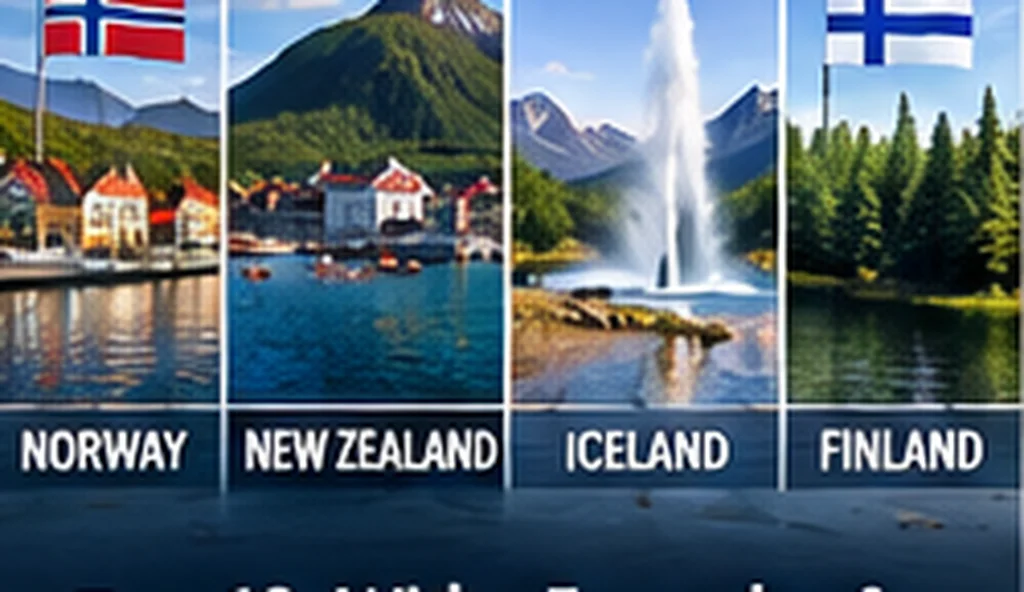
The idea of broader public participation is not entirely new. Around the world, governments, communities, universities and civil-society organisations have experimented with ways to involve people more directly in public decisions. These examples provide practical evidence, although none is a complete model that can simply be copied everywhere.
Taiwan's vTaiwan process has used online tools and structured consultation to bring together citizens, officials and stakeholders around policy questions. France's Citizens' Convention for Climate brought randomly selected citizens together to deliberate on climate proposals. Barcelona's Decidim platform provides digital infrastructure for participation and collaborative decision-making. Porto Alegre's participatory budgeting experience helped make local spending priorities a subject of direct citizen involvement.
Switzerland offers examples of direct-democratic instruments, including popular initiatives and referendums, within a distinctive constitutional and political context. Ireland's citizens' assemblies have brought randomly selected participants together to examine difficult questions and make recommendations. Each example raises questions about representativeness, agenda-setting, public understanding, political response and implementation.
Organisations and research groups also contribute. The OECD has documented innovative citizen participation and deliberative processes. DemocracyNext explores democratic innovation. Stanford's Deliberative Democracy Lab researches deliberative polling and public opinion. Doughnut Economics Action Lab supports communities exploring ways to meet human needs within ecological limits.
These initiatives should be examined critically. What was the mandate? Who took part? How were participants selected? What evidence did they receive? Did decision-makers respond? What changed afterwards? A collection of inspiring examples is not enough; the task is to understand what works, for whom, under what conditions and with what safeguards.
19. The Age of AI and Robotics: Who Protects the Public?

Artificial intelligence and robotics are changing how work is organised, how information is produced, how services are delivered and how decisions are made. These technologies may improve productivity, scientific discovery, healthcare, accessibility and safety. They may also displace tasks, intensify surveillance, reproduce bias, concentrate market power and create new security risks.
The effects will not be determined by technology alone. Ownership, governance, labour-market institutions, education, taxation, competition and public policy will influence who benefits. If productivity rises but gains accrue mainly to a small number of owners, many people may experience disruption without sharing proportionately in the benefits. If access is broad and institutions adapt, technology could reduce dangerous work and expand human capability.
Public protection requires more than a general promise of responsible innovation. People need to know when automated systems affect important decisions, how to challenge errors, what data is used and who is accountable. High-risk applications may require testing, independent oversight, documentation, human review and clear routes for redress.
AI systems should not be treated as neutral authorities. They can make mistakes, reflect limitations in data and produce convincing but unsupported answers. Human judgement, professional standards and independent verification remain essential, particularly in healthcare, justice, employment, finance and public administration.
The central question is not whether society should stop technological progress. It is how to shape it so that innovation serves people. Who owns the systems? Who controls the data? Who carries the risks? Who receives the gains? And what democratic safeguards ensure that powerful technologies remain accountable to the public?
20. Who Owns the Future Economy?
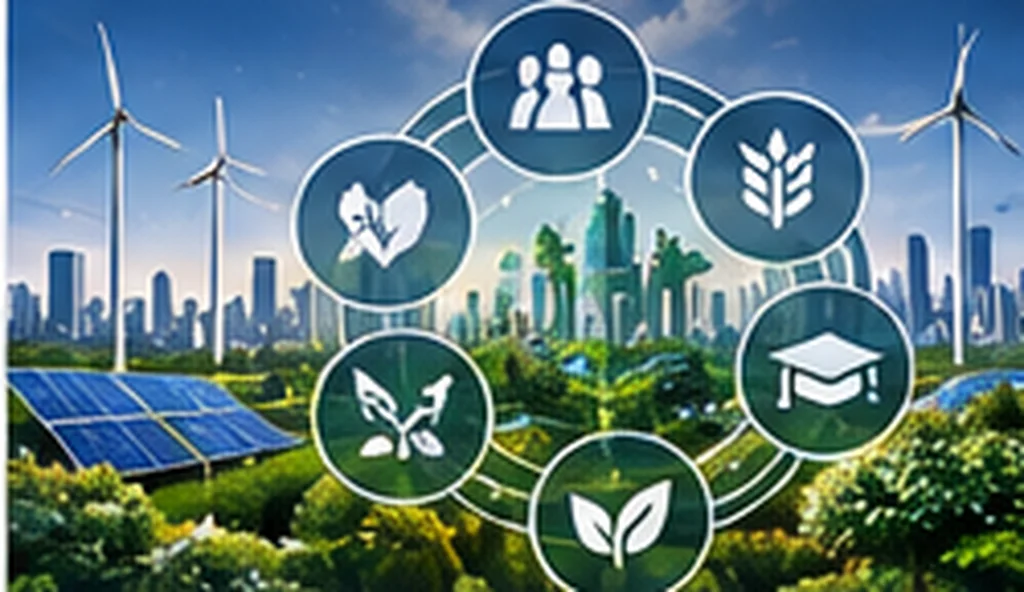
The future economy will be shaped not only by what technology can produce, but by who owns the assets, infrastructure, data and intellectual property that make production possible. As automation and AI expand, questions of ownership become questions about income, bargaining power, security and participation.
Traditional private ownership can support investment, entrepreneurship and clear responsibility. Public ownership can secure democratic control over certain essential services or strategic assets, but it requires effective governance and accountability. Cooperatives and employee-owned businesses can give workers a direct stake in decisions and returns, although they need access to finance, skills and markets. Social enterprises and community ownership offer further approaches.
No ownership model is automatically superior in every context. The right arrangement depends on the purpose of the asset, the risks involved, the need for investment, the degree of competition and the interests of those affected. A competitive market may work well for some goods and poorly for natural monopolies or essential infrastructure. Public provision may protect universal access but can also become inefficient if accountability is weak.
As technology changes work, societies may need to reconsider how productivity gains are distributed. Options include stronger skills investment, profit-sharing, employee ownership, portable benefits, social insurance, public investment funds and carefully designed tax systems. Each raises questions about incentives, fairness, cost and implementation.
The goal should be an economy in which people can contribute, innovate and build secure lives, while the gains from collective progress are not detached from the public whose knowledge, infrastructure and institutions help make that progress possible.
21. Education, Environment and the Future of Humanity

Human flourishing depends on more than income. Education can expand knowledge, confidence, critical thinking and the ability to participate in society. A healthy environment provides the foundations on which economies and communities depend. Decisions made today will shape the opportunities available to future generations.
Education systems face a difficult balance. They must help people develop essential knowledge and practical skills while encouraging curiosity, creativity, independent judgement and the ability to learn throughout life. A narrow focus on examination performance or immediate labour-market needs can overlook citizenship, emotional development, collaboration, arts, scientific literacy and ethical reasoning.
Environmental challenges are equally interconnected. Climate change, biodiversity loss, pollution, soil degradation and pressure on water systems affect health, food, housing, migration and economic stability. Solutions require local knowledge and international cooperation. They also involve trade-offs over energy, land use, consumption, jobs and the distribution of costs.
A flourishing society should not treat the environment as an unlimited resource or education as merely a pipeline for employment. Both are foundations of human capability. People need the knowledge to understand complex issues and the ecological conditions that make healthy lives possible.
The question is how to build institutions that take long-term responsibilities seriously. Can education encourage independent thought and practical problem-solving? Can economic development improve living standards while respecting ecological limits? Can decisions account for people who do not yet have a voice, including future generations? These questions belong at the centre of any serious discussion about the future.
22. Different Ways to Create Change: Activism Beyond Protests and Marches

Public protest has played an important role in drawing attention to injustice and demanding change. Marches, demonstrations, strikes and campaigns can make ignored issues visible and create pressure for institutions to respond. But activism is broader than public protest, and people contribute in many different ways.
Some people organise locally, support neighbours, volunteer, build community projects or help people navigate public services. Others research policy, analyse data, document problems, create films, write, teach, design technology, develop businesses or contribute professional expertise. Digital campaigns can connect people across distances, while local initiatives can test practical solutions on the ground.
Different methods suit different objectives. A campaign may raise awareness but not produce a workable policy. A pilot project may demonstrate an alternative but struggle to scale. Legal action may clarify rights but take years. Dialogue may build understanding but fail if decision-makers do not respond. Effective change often combines methods and adapts as circumstances evolve.
People also have different capacities. Not everyone has the time, health, money, confidence or inclination to become a public campaigner. Participation should not be measured only by visibility or volume. Quiet, consistent contributions can be valuable, and people should be able to take part without being pressured into a particular role or identity.
The Forum should recognise a wide range of contributions and connect people with opportunities that match their skills and interests. The question is not simply how to protest against what exists, but how to help create, test and improve what could exist instead.
23. The Questions We Must Not Avoid: Five Challenges for a Better Future
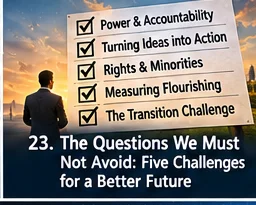
Any serious proposal to improve society must face difficult questions. It is easy to describe a more flourishing world in broad terms. It is harder to explain how decisions would be made, how rights would be protected, how power would be constrained and how competing interests would be reconciled.
First: power and accountability. Who sets the agenda, controls resources and makes final decisions? How can people challenge those decisions, expose conflicts of interest and remove or correct those who abuse authority? A forum designed to question power must be transparent about its own power.
Second: turning ideas into decisions. How do proposals move from discussion to testing, funding, legislation or practical delivery? Who evaluates them, and what happens when institutions disagree? Participation that has no visible route to influence can become tokenistic.
Third: rights and minorities. How can a majority make collective decisions without overriding fundamental rights or silencing smaller groups? Any process needs safeguards, independent review and protection for freedom of expression, association and conscience.
Fourth: measuring flourishing. Which outcomes matter, and how should they be balanced? Income, health, security, freedom, relationships, opportunity, environmental quality and subjective wellbeing all reveal different aspects of life. No single indicator can capture everything.
Fifth: transition without instability. How can societies experiment and reform without creating avoidable hardship, undermining essential services or ignoring people who bear the costs? A credible approach needs evidence, pilots, feedback, honest assessment and a willingness to change course. These questions are not reasons to abandon ambition. They are the tests that make ambition responsible.
24. From Discussion to Action: How Could We Make This Happen?

A Human Flourishing Forum should begin with a modest, practical purpose: create a reliable place where people can explore important questions, compare evidence, develop proposals and connect discussion with real-world learning. It should not claim authority to govern or present itself as the voice of everyone.
An initial programme could have several connected strands. Open public discussions would invite questions and perspectives. Research summaries would explain evidence, uncertainty and competing interpretations. Deliberative groups could examine selected issues in depth. A public ideas library could record proposals, sources, criticisms and revisions. Local projects could test practical approaches and report their results.
The process should be transparent. Publish who funds the work, how participants are selected, how topics are chosen, what standards are used to assess evidence and how conflicts of interest are handled. Make participation accessible and provide clear explanations of how contributions influence the next stage.
Start with a limited number of questions rather than attempting to redesign everything at once. Choose issues where public understanding, institutional learning or local experimentation could make a meaningful difference. Define the problem, map stakeholders, gather evidence, consider alternatives, identify risks and agree how outcomes will be evaluated.
The Forum should build partnerships without becoming dependent on any single funder, political party, corporation or institution. It should protect its independence, welcome criticism and publish unsuccessful experiments as well as successes. Progress should be judged not by how many people agree with the Forum, but by the quality of inquiry and the usefulness of what it helps people learn.
25. A Living Document: An Idea That Must Be Allowed to Evolve
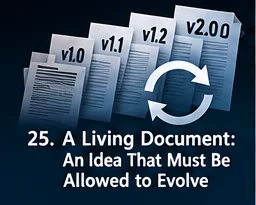
This article is not intended to be a final blueprint. It is a starting point for a continuing conversation about how societies might better support human flourishing. Its arguments, examples and proposals should remain open to scrutiny as new evidence emerges and as people contribute perspectives that may not yet have been considered.
A living document needs a visible method for change. Updates should be dated and versioned. Significant revisions should explain what changed and why. Readers should be able to distinguish established evidence from interpretation, speculation and proposals. References should be checked, links maintained and corrections made openly.
The process must protect unconventional and minority ideas without treating every claim as equally credible. Openness does not mean abandoning standards. Claims should be assessed according to evidence, reasoning and relevance. People should be able to disagree respectfully, challenge assumptions and request clarification without being treated as opponents.
Artificial intelligence may help organise material, summarise research or identify questions, but it should not become the authority that decides what the Forum believes. AI-assisted material must be checked by people, important sources must be traceable and responsibility for publication must remain human.
The Forum must apply its own principles to itself. It should be transparent about governance, funding, access, decision-making and conflicts of interest. It should invite criticism, acknowledge mistakes and be prepared to change its structure if it fails to serve its purpose. A project that asks society to evolve must be willing to evolve itself.
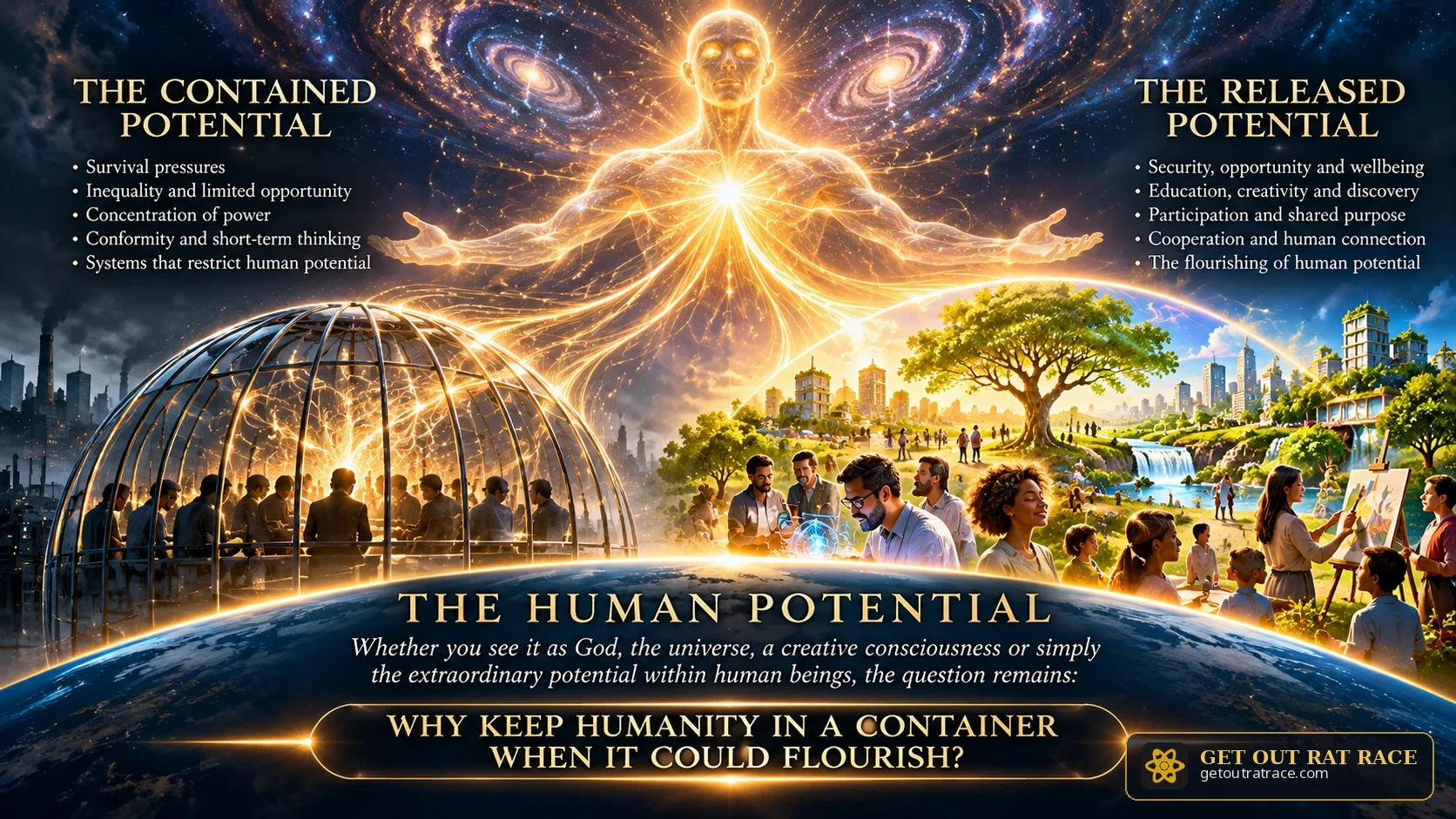
26. The Human Potential: From a Contained Humanity to a Flourishing World
27. A Question for All of Us
26. The Human Potential: From a Contained Humanity to a Flourishing World
27. A Question for All of Us
26. The Human Potential: From a Contained Humanity to a Flourishing World
There is perhaps a much bigger question sitting beneath everything we have discussed so far.
What if the greatest limitation facing humanity isn't a lack of resources, knowledge, technology or intelligence, but the conditions in which human potential is currently allowed to develop?
Imagine humanity as an enormous source of creative potential. Every individual possesses different combinations of imagination, intelligence, curiosity, compassion, creativity, ambition and the ability to discover, learn and contribute.
Yet the circumstances in which people are born and live can profoundly influence how much of that potential they ever get to express.
For some, life becomes an almost continuous struggle to meet basic needs. Others face limited access to education, opportunity, resources or meaningful participation in society. Many spend enormous amounts of their lives adapting to economic pressures, institutional structures and expectations they had little involvement in creating.
How much human potential remains undiscovered simply because people never have the opportunity to explore it?
Perhaps we are judging humanity by what it currently produces without properly considering what humanity could produce under different conditions.
Are we keeping human potential inside a container?
Imagine human potential as a powerful source of energy, creativity and possibility. Now imagine placing that potential inside a container.
The container represents the combined restrictions that can emerge from economic insecurity, unequal opportunities, concentrations of power, limited political participation, social expectations and systems that prioritise short-term interests over long-term human wellbeing.
The potential is still there. But its opportunities for expression are restricted.
This isn't necessarily the result of one person, organisation or government deliberately designing a system to suppress humanity. It can emerge through the accumulation of institutions, incentives, historical decisions and circumstances that collectively limit what people are able to become.
The question is whether we should simply accept those limitations as inevitable, or begin exploring how to change the conditions themselves.
From survival to self-actualisation
Maslow's hierarchy of needs offers one useful way to understand this. When people struggle to secure food, shelter, safety and basic stability, those demands can consume much of their attention and energy.
When those foundations are more secure, people may have greater opportunities to develop relationships, confidence, independence, creativity, purpose and self-actualisation.
This doesn't mean everyone follows the same hierarchy or that human needs can be reduced to a single pyramid. But it raises an important question: what would society look like if more people had the genuine opportunity to develop their capabilities, pursue meaningful lives and contribute beyond the demands of survival?
The Nordic countries offer examples of how social protections, public services and economic opportunity can support those conditions. But they are not necessarily the final destination. They are examples from which we can learn.
Is human potential something greater?
There is another dimension to this question, and it is one that people will interpret differently.
Some understand human existence through the Abrahamic traditions and the idea of a creator. Others explore ideas found in Hermetic philosophy, including the principle that all is mind. Others speak of universal consciousness, interconnectedness or a divine source.
And many people are atheists, understanding human consciousness and creativity through evolution, biology, neuroscience and the natural world.
We don't need to resolve these differences here. Nor should we pretend that distinct religious, philosophical and scientific explanations are interchangeable.
But consider this: even if there were no higher power, the argument for human flourishing would remain. Human beings still possess extraordinary capacities. We still have the ability to create, discover, cooperate, understand, care for one another and improve the conditions in which we live.
And if someone does believe that humanity is an expression of something divine or greater than itself, then the idea takes on another layer of meaning.
Different beliefs. Different interpretations. One shared potential.
One for all and all for one
This brings us to a fundamental question about the way we organise society.
Should our overriding objective be competition, individual advantage and the survival of the fittest? Or should we be exploring how individual freedom and ambition can exist alongside cooperation, mutual responsibility and collective wellbeing?
Competition can encourage innovation, effort and excellence. Individual ambition can produce extraordinary achievements. Neither should automatically be treated as a problem.
But when competition becomes domination, when individual advantage comes at the expense of others, or when institutions protect concentrated power rather than serve the public, we need to question the principles guiding the system.
Nature itself demonstrates both competition and cooperation. Human civilisation has developed through both, but our ability to collaborate, share knowledge and organise collectively is among our greatest strengths.
Perhaps a principle worth aspiring to is simple: One for all and all for one.
Not a demand for uniformity. Not the removal of individual freedom. Not a system in which everyone must think alike.
Rather, a recognition that our individual futures are connected, and that the flourishing of one person should not require the unnecessary deprivation of another.
A society should be capable of supporting individual achievement while ensuring that the opportunities and benefits of progress are not reserved for a privileged few.
What if we designed society around human potential?
Whether a country describes itself as capitalist, socialist, communist, social democratic, or something entirely different, shouldn't we be asking the same fundamental questions?
Does its system allow people to meet their basic needs? Does it protect individual freedoms and human rights? Does it distribute opportunities fairly? Does it encourage creativity, education and discovery? Does it allow people to participate meaningfully in decisions that affect their lives? Does it prevent excessive concentrations of power? Does it protect the environment and the interests of future generations?
And ultimately, does it create the conditions in which human beings can flourish?
No political label automatically answers those questions. No system should be exempt from scrutiny simply because it is familiar, historically established or ideologically popular.
The objective should not be to defend a particular model. It should be to examine what works, identify what doesn't, learn from different approaches and remain willing to improve.
Perhaps we have spent too much time asking people to adapt themselves to the systems we have created, and not enough time asking how those systems could be designed around the potential of the people they are supposed to serve.
A shared responsibility
The Human Flourishing Forum is not suggesting that we can create a perfect world, eliminate disagreement or discover one political and economic arrangement that works identically for everyone.
Nor does it claim to have all the answers.
It begins with a much simpler proposition: things can be better, and we have a responsibility to explore how.
Every conversation that challenges an assumption, every idea that offers a different possibility, every contribution that helps us understand a problem and every practical experiment that teaches us something can form part of that process.
We don't need everyone to agree about the origin of consciousness, the existence of God or the ultimate nature of reality to share an interest in making the world a better place.
We don't need everyone to become a philosopher, activist, politician or scientist. We need people to contribute in the ways they can.
Whether you see human potential as a divine spark, an expression of universal consciousness, the remarkable product of evolution or simply the extraordinary capabilities of the human mind, the question remains:
Why keep humanity in a container when it could flourish?
Perhaps humanity's greatest untapped resource isn't beneath the ground, in our banks or in our technology. Perhaps it is the unrealised potential of the human beings already living on this planet.
And perhaps the next great step in our development is not simply to build more powerful technologies or larger economies, but to create societies in which more people have the opportunity to discover what they are capable of becoming.
27. A Question for All of Us

We have explored political participation, economic systems, the concentration of power, information, technology, education, the environment and the possibilities of collective action. These subjects are often discussed separately, yet they are connected by a larger question: what kind of world are we trying to create, and who gets to help shape it?
There will be no universal agreement on every answer. People have different histories, beliefs, ambitions and ideas about what makes a good life. A flourishing society should make room for that diversity. It should protect individual rights while recognising that our lives are interconnected and that many challenges require cooperation.
The Human Flourishing Forum does not claim to possess a perfect model or a final solution. It begins with the belief that the systems we inherit can be examined, that alternatives can be explored and that people should have meaningful opportunities to contribute to the decisions that shape their future.
Perhaps the most important shift is from asking people only to choose between the options already presented to them, towards giving them a greater role in examining how those options are created. From accepting the future as something that simply happens, towards treating it as something we can question, influence and help build.
So here is the question for all of us: if we have the knowledge, creativity and collective capacity to explore better ways of organising society, why should we leave that possibility unexplored?
What would change if more people had the opportunity to contribute their ideas, develop their capabilities and participate in shaping the world they share? And what might become possible if we judged our systems not only by what they produce, but by the lives they make possible?
The conversation does not end with this article. It begins with what we choose to do next.
Frequently Asked Questions
What is the Human Flourishing Forum?
The Human Flourishing Forum is an open, pluralistic inquiry into how societies might better support human wellbeing, freedom, opportunity, democratic participation, creativity and environmental stewardship. It is a living exploration rather than a fixed political blueprint.
What does human flourishing mean?
Human flourishing goes beyond basic survival or economic output alone. It refers to the conditions that allow people to meet their fundamental needs, enjoy freedom and security, develop their capabilities, participate meaningfully in society and pursue purposeful, fulfilling lives.
Why explore alternatives to existing political and economic systems?
Familiar systems can deliver real strengths while still leaving persistent gaps in representation, inequality, environmental sustainability and public trust. Examining what works and what falls short allows societies to learn and adapt rather than treating inherited arrangements as unchangeable.
Does the Forum support a particular political ideology?
No. The Forum does not promote capitalism, socialism, communism or any single party or doctrine. Instead, it asks practical, evidence-led questions about which policies, institutions and safeguards genuinely improve human lives.
What is meant by democracy beyond elections?
Voting in periodic elections remains essential, but democracy beyond elections explores complementary tools such as citizens assemblies, deliberative polling, participatory budgeting and transparent digital platforms that let citizens examine evidence and help shape priorities between elections.
How can ordinary people participate?
People do not need to be politicians, academics or full-time activists to contribute. Participation can start with questioning assumptions, sharing informed perspectives, engaging in local civic and community initiatives, and exploring constructive ideas through spaces like the Human Flourishing Forum and Get Out Rat Race.
What is meant by human potential and self-actualisation?
Drawing on ideas such as Maslow’s hierarchy of needs, the article explores how economic insecurity and restrictive conditions can contain human capability, whereas secure foundations, education and fair opportunity allow far more people to discover and express what they are capable of becoming.
References and Further Reading
The following institutional reports, research centres and civic platforms offer starting points for examining the evidence and ideas explored in this article:
The following are starting points for checking and expanding the article's factual and institutional references. They are not presented as sources for every statement in the reconstructed text. Before publication, verify that each cited source supports the precise claim attached to it.
OECD — Innovative Citizen Participation and New Democratic Institutions — https://www.oecd.org/en/publications/innovative-citizen-participation-and-new-democratic-institutions_339306da-en.html
OECD — Government at a Glance 2025 — https://www.oecd.org/en/publications/government-at-a-glance-2025_0efd0bcd-en.html
UK House of Commons Library — General Election 2024: turnout — https://commonslibrary.parliament.uk/general-election-2024-turnout/
UNDP — Human Development — https://hdr.undp.org/about/human-development
DemocracyNext — About — https://www.demnext.org/about
Stanford Deliberative Democracy Lab — https://deliberation.stanford.edu/people/james-fishkin
Decidim — About the platform — https://docs.decidim.org/en/develop/understand/about.html
World Bank — Participatory Budgeting and Public Expenditure — https://documents1.worldbank.org/curated/en/243991468762305188/pdf/298160018047141re0and0Public0Action.pdf
Doughnut Economics Action Lab — The Doughnut — https://doughnuteconomics.org/doughnut
World Justice Project — https://worldjusticeproject.org/
UK Parliament — Petitions guidance — https://guidetoprocedure.parliament.uk/articles/xfTzCkCp
UK AI Security Institute — https://www.gov.uk/government/organisations/ai-security-institute
Continue the Journey
Explore the three core pillars of Get Out Rat Race alongside our Cornerstones essays:
- Purpose — Meaning, authenticity, Maslow and self-actualisation.
- Reality — Science, consciousness, philosophy and systems.
- Build — Ownership, skills and creating independent value.
- Cornerstones — Society, economics, power and human flourishing.
Related Articles
- From Survival to Self-Actualisation: What Can the World Learn From China? — how material security connects to human flourishing.
- Is Voting Pointless? Civic Engagement Beyond the Ballot Box — exploring turnout, trust and participation.
- Who Creates the Money We Live By? — understanding how the modern financial system works.
- Abraham Maslow, Success and Self-Actualisation — becoming who you were born to be.
- How Do We Know What We Know? — science, consciousness and intellectual humility.
- Why Everyone With a Passion Needs Their Own Platform — ownership and independence in the modern economy.
Join the Conversation
The future of society should not be left to evolve by default. It should be something we actively explore, question and help shape.
Don't take any single viewpoint on faith — question assumptions, explore alternative ideas and share your perspective with others who care about human flourishing.
Share your perspective with Get Out Rat Race → · Continue the discussion on Skool →