Introduction: The value of having difficult conversations
Some of the most important conversations we can have are also the most uncomfortable.
Immigration, national identity, religion, multiculturalism and the future of British society are subjects that can provoke strong emotions. They touch on people's beliefs, histories, values, identities and perceptions of what society should become.
But precisely because these subjects matter, we should be able to discuss them openly.
Recently, I watched a conversation involving a Christian priest and another participant discussing immigration, Christianity, multiculturalism and whether humanity can genuinely live together in unity.
The conversation raised some important theological and philosophical questions. One participant, who openly acknowledged that he was speaking as a layman, offered a particular interpretation of the Bible and the Tower of Babel. He suggested that humanity, in its fallen state, cannot achieve unity and that God divided people into different tribes because of humanity's inability to work together.
The priest appeared to agree with parts of the discussion, nodding as the other participant developed his argument.
It is this particular exchange that I want to explore.
Not because I believe people should be prevented from expressing these views, nor because I want to attack either individual, but because the ideas being discussed have wider implications for how we understand society, religion, cultural identity and our relationships with people who are different from us.
I also want to acknowledge something positive: it takes a degree of conviction to participate in public conversations about subjects that people know can be controversial. The speakers deserve credit for being willing to express their beliefs and enter into a discussion that many people might avoid.
We should encourage more conversations like this.
However, being willing to express an opinion does not automatically make that opinion accurate. Equally, challenging someone's argument does not mean attacking their character.
That distinction is important.
The purpose of this article is not to establish that one participant is a good person and another is a bad person. It is to examine the arguments, explore the context, distinguish interpretation from established fact and consider whether the conclusions being drawn are justified.
The aim of argument is not victory, but progress

The French philosopher and essayist Joseph Joubert is attributed with the words:
"The aim of argument, or of discussion, should not be victory, but progress."
I think this is a particularly valuable principle when discussing subjects such as religion, immigration and national identity.
Too often, conversations become competitions. People concentrate on defending their position, exposing weaknesses in someone else's argument or securing the approval of an audience.
The original question can quickly become secondary to the desire to win.
But what have we actually achieved if we leave a conversation having defeated someone's argument without learning anything ourselves?
A productive discussion should allow us to:
- Understand why someone holds a particular belief.
- Examine the evidence supporting that belief.
- Recognise where our own assumptions may be mistaken.
- Consider interpretations that we may not have encountered before.
- Identify what we genuinely know and what remains uncertain.
- Change our minds when the evidence warrants it.
This does not mean that every argument is equally valid or that we should avoid reaching conclusions.
Some claims are demonstrably false. Some interpretations are better supported than others. Some arguments contain contradictions or rely on inaccurate historical information.
We should be prepared to say so.
But we can challenge those things without resorting to personal insults, assumptions about someone's character or attempts to discredit them simply because we disagree.
Challenge the argument, not the person making it.
Note: the Joubert quotation is a recognised English translation, attributed to Joseph Joubert; it is not presented as his exact original French wording.
Intellectual humility: The limits of what any of us can know

There is another principle that I think is particularly important in this discussion: epistemic humility.
Epistemology is the branch of philosophy concerned with knowledge, how we acquire it, what justifies our beliefs and the limits of what we can know.
Intellectual or epistemic humility is the recognition that our knowledge is incomplete, our perspectives are limited and our confidence can sometimes exceed the evidence available to us.
This applies to everyone involved in a discussion.
It applies to the priest, the lay participant, the person watching the video, the person writing this article and even the artificial intelligence tools that may be used to help research and analyse the subject.
None of us should be exempt from scrutiny.
We all approach subjects with particular experiences, assumptions, education, cultural backgrounds and existing beliefs. These influence what we notice, how we interpret information and which explanations appear convincing to us.
Even when we have access to substantial information, we rarely possess the complete context.
This is particularly relevant when discussing theology and history. A biblical passage can be interpreted within different theological traditions. An historical event can be understood through different sources and perspectives. Scientific research can provide strong evidence while still having limitations, uncertainties and areas requiring further investigation.
Recognising these limitations does not mean abandoning the search for truth.
It means approaching that search more responsibly.
There is a difference between saying that objective truth does not exist and recognising that our access to it is fallible.
We may believe that something is true, but we should still ask how we know it, what evidence supports it, what assumptions underpin our conclusion and what might cause us to reconsider.
The aim should be to get as close to an accurate understanding as we reasonably can, rather than pretending that our current understanding is complete.
Why context, framing and interpretation matter

One of the difficulties with conversations about religion and politics is that a statement can sound convincing when removed from its wider context.
A biblical passage may be quoted without examining the surrounding chapter, the historical circumstances in which it was written or how it has been interpreted within different Christian traditions.
An historical event may be presented as though there is only one explanation, despite historians debating its causes and consequences.
A scientific study may be used to support a conclusion that the researchers never actually made.
We also need to pay attention to framing.
The way a question is presented can influence the answer people give.
For example, asking whether God divided humanity into different nations is not necessarily the same as asking whether the Tower of Babel condemns collective pride, the pursuit of power or humanity's desire to make a name for itself.
Those questions may overlap, but they are not identical.
Likewise, discussing the importance of national culture is not the same as demonstrating that people from different cultural backgrounds cannot coexist.
We need to understand exactly what is being claimed before deciding whether the argument is sound.
It is also important to stay on topic. A discussion about biblical unity should not automatically become an argument about immigration statistics. A discussion about immigration policy should not be settled by quoting a theological passage without explaining its relevance.
Different types of claims require different types of evidence.
For example:
- Theological claims: What does the Bible say, and how have Christian traditions interpreted it?
- Historical claims: What happened, when did it happen, and what do reliable historical sources establish?
- Scientific claims: What does the research actually demonstrate, and what are its limitations?
- Empirical claims: What evidence supports statements about immigration, integration, economics or social cohesion?
- Philosophical claims: What assumptions and principles underpin the argument?
- Political claims: What policies are being proposed, and what are their likely consequences?
These categories can inform one another, but evidence in one category does not automatically settle questions in another.
The conversation: Can humanity genuinely live in unity?
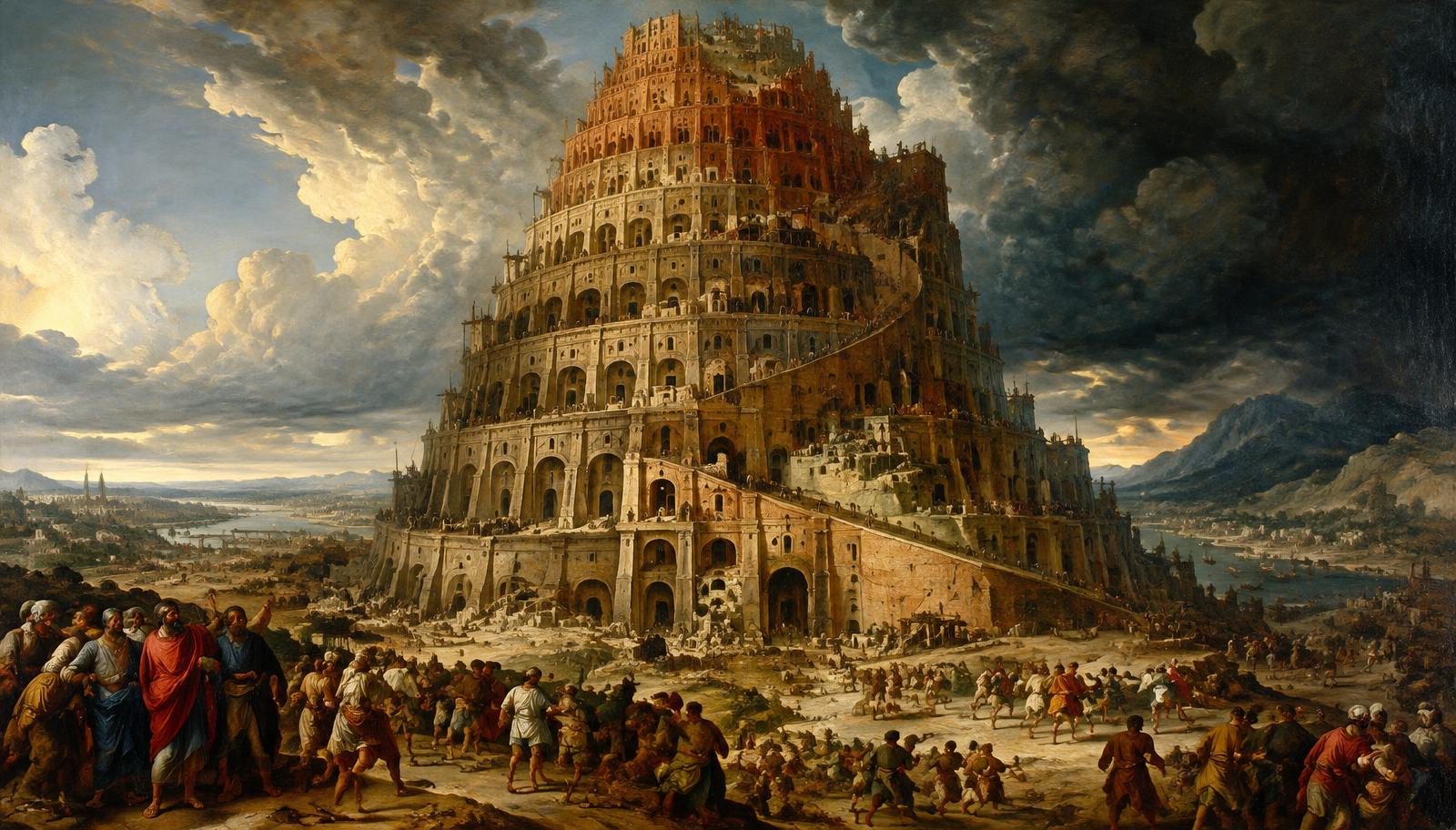
The particular section of the video that prompted this article occurs during the discussion of biblical society and the Tower of Babel.
One participant, while acknowledging that he is speaking as a layman, suggests that humanity is fallen and that people cannot genuinely achieve unity in the way some might imagine.
He refers to the biblical account of Babel, arguing that God divided humanity into different tribes because people cannot work together without going against God.
He also connects hyper-individualism and multiculturalism, describing them as deeply damaging to society.
These are strong claims, and they deserve careful examination.
The priest listens and appears to agree with aspects of the argument, allowing the participant to continue.
I think this is where the conversation becomes particularly interesting.
The question is not whether the participant is entitled to express his interpretation. He is.
The question is whether the interpretation accurately reflects the biblical text, whether alternative interpretations deserve consideration and whether the conclusions being drawn are justified.
What does the Tower of Babel actually say?
The relevant passage is Genesis 11:1–9.
In the account, humanity shares one language and gathers together to build a city and a tower. The people want to make a name for themselves and avoid being scattered across the earth.
God confuses their language and scatters them.
There are different theological interpretations of why God intervenes.
One prominent interpretation sees the story as a warning about collective pride, human ambition, the pursuit of power and the desire to establish a single dominant human project.
However, the passage does not explicitly state that multicultural societies are inherently wrong, that different peoples cannot coexist or that international cooperation is sinful.
The broader context also matters.
Genesis 10, often called the Table of Nations, describes the spread of different peoples and territories. The narrative then moves towards Abraham, through whom God promises that all nations will be blessed.
This wider biblical context deserves consideration before using Babel as a general argument against cultural diversity or human cooperation.
A person can interpret Babel as a warning about humanity's collective ambitions without necessarily concluding that people from different backgrounds cannot live together.
Those are different propositions.
What about Christian unity?
The conversation also refers to Galatians 3:28 and Colossians 3:11, which describe the unity of believers in Christ across distinctions such as Jew and Gentile.
This raises an important theological question.
If Christianity teaches that people from different ethnic and social backgrounds are united in Christ, how should that influence the way Christians understand people from other nations and cultures?
This does not automatically mean that national borders should disappear or that political communities cannot have distinct identities.
But it does invite Christians to consider whether cultural differences should be treated as barriers to human dignity, compassion and fellowship.
The tension between spiritual unity and political diversity deserves more discussion than simply declaring that humanity cannot work together.
Multiculturalism and hyper-individualism: Are they really the same?

Another statement in the conversation equates hyper-individualism with multiculturalism.
I think these concepts need to be separated.
Individualism concerns the importance placed on the individual, personal autonomy and individual rights.
Multiculturalism concerns the coexistence of different cultural, ethnic or religious communities within a society, and the ways institutions and individuals respond to that diversity.
They may overlap in particular political philosophies, but they are not interchangeable.
A multicultural society can have strong shared institutions, social responsibilities, community obligations and collective identities.
Equally, a culturally homogeneous society can be highly individualistic.
If the concern is social fragmentation, declining community participation, weakening shared values or a lack of common purpose, those are legitimate subjects to investigate.
But we need to identify the actual problem and examine the evidence rather than treating different concepts as though they mean the same thing.
The responsibility of people who speak with influence

There is another aspect of the conversation I think is worth considering.
The priest's role is different from that of the participant who explicitly identifies himself as a layman.
A priest is not automatically responsible for correcting every statement made by another person in a conversation. Nor can we know his intentions simply from a short section of footage.
However, when someone speaks from a position of religious authority or public influence, there is a reasonable question about the responsibility that comes with that position.
When a participant makes strong theological claims, particularly claims that could influence how people view other communities, should a priest simply listen and nod, or should he help clarify the theological context?
For example, when the suggestion is made that humanity cannot work together because of God's intentions, a priest might reasonably be expected to explore what the biblical text actually says, distinguish interpretation from explicit teaching and explain where Christians may disagree.
That does not mean shutting down the participant or preventing him from expressing his beliefs.
It means helping the audience understand the difference between an individual's interpretation and an established Christian teaching.
Some viewers might interpret the priest's lack of visible challenge as agreement or endorsement. Others might see it simply as allowing someone else to finish speaking.
We cannot determine which interpretation is correct from the footage alone.
But it raises a wider question about responsibility.
When people with influence allow strong claims to go unchallenged, audiences may interpret silence as agreement. This can reinforce assumptions and potentially deepen divisions that might have been avoided through clarification.
The responsibility is not exclusive to religious leaders. It applies to politicians, journalists, academics, commentators, influencers and anyone who speaks publicly about subjects affecting other people.
The freedom to express an opinion is important, but so is the responsibility to communicate carefully and acknowledge the limits of what we know.
Examining the arguments: Respect for people does not mean accepting every claim

Having considered the purpose of the discussion, we can now examine the specific arguments made in the video.
I do not believe that a person should be dismissed simply because their position is religious, conservative, restrictive on immigration or critical of multiculturalism.
Equally, a claim should not be accepted simply because it is expressed with religious conviction or confidence.
The earlier analysis of this conversation identified several areas that deserve further investigation.
1. Welcoming strangers and maintaining culture
The priest describes a biblical tension between welcoming strangers and maintaining cultural identity.
There are genuine biblical themes concerning hospitality, religious faithfulness and the responsibilities of a community.
Leviticus 19:33–34 instructs the Israelites not to mistreat foreigners living among them. Deuteronomy 10:17–19 emphasises God's care for the foreigner. Matthew 25:35–40 presents welcoming the stranger as an expression of service to Christ.
These passages should be considered alongside the biblical instructions concerning religious identity and faithfulness.
The question is whether maintaining a religious tradition necessarily requires restrictive immigration or cultural exclusion.
That conclusion needs to be demonstrated rather than assumed.
2. Does God intend humanity to remain divided?
The lay participant's interpretation of Babel raises questions about human pride, collective ambition, the meaning of different nations and the relationship between unity and diversity.
The text deserves to be read in its wider context, particularly alongside Genesis 10 and 12.
The passage does not explicitly establish that multicultural societies are contrary to God's intentions.
3. Christianity and ethnic divisions
The references to Galatians 3:28 and Colossians 3:11 raise questions about the relationship between Christian unity and national identity.
The idea of Christians as a new or third people also appears in early Christian literature, although the attribution made in the video to Origen requires further verification.
The central question is how spiritual unity should influence the way Christians treat people across national and cultural boundaries.
4. Britain's changing religious identity
The priest argues that Britain has turned away from Christianity.
There is evidence of significant change in religious identification. In the 2021 Census, 46.2% of people in England and Wales identified as Christian, compared with 59.3% in 2011. The proportion reporting no religion increased from 25.2% to 37.2%.
However, these figures measure self-reported religious affiliation, not necessarily belief or religious practice.
Whether this represents Britain turning away from God is a theological interpretation, not something the Census can establish.
The further suggestion that immigration caused this change requires separate evidence.
5. John Chrysostom and the rise of Islam
One historical claim in the conversation requires particular attention.
John Chrysostom lived approximately 349–407 CE. Islam emerged in the seventh century, more than two centuries after his death.
His writings commonly known as the Homilies Against the Jews were delivered in the late fourth century. They cannot be used as a direct explanation of the rise of Islam in the seventh century.
This is a clear example of why historical claims should be checked against dates and original sources.
6. Immigration, integration and economic contribution
The opening discussion includes claims about legal migrants, integration and public finances.
These are empirical questions.
The fiscal impact of immigration varies according to factors such as age, earnings, skills, family circumstances and immigration route. It is not accurate to treat all migrants as one uniform group.
Similarly, integration needs to be defined before it can be measured.
A serious discussion should distinguish between economic contribution, language, education, social participation, shared institutions and cultural identity.
7. The relationship between Christianity and political identity
The priest argues that Christians should shape the culture rather than simply live under it.
There is a legitimate discussion about the historical influence of Christianity on British institutions, education, law, literature and public life.
However, encouraging Christian values through persuasion and public participation is not necessarily the same thing as seeking to enforce religious or cultural conformity.
The Great Commission in Matthew 28:19 calls Christians to make disciples of all nations. It does not, by itself, establish a political mandate for immigration restrictions or religious uniformity.
These are separate questions that require their own arguments.
A wider principle: Everyone and everything should be open to scrutiny

One thing I want to make particularly clear is that this article is not intended to position its author as an authority who has all the answers.
I am learning too.
The speakers should be examined. My interpretation should be examined. The sources I use should be examined. And any research or analysis produced with AI should also be checked.
AI can be useful for organising information, identifying potential inconsistencies, locating sources and exploring alternative interpretations. But it can also produce inaccurate information, misunderstand context, misattribute quotations or present uncertain claims with unwarranted confidence.
It should be treated as a research aid, not an unquestionable authority.
The same principle applies to books, articles, academic papers, religious authorities, politicians, journalists and online commentators.
Whenever possible, we should go back to the original material.
If someone quotes the Bible, examine the passage and its context.
If someone refers to a historical event, check the dates and historical evidence.
If someone cites scientific research, read what the researchers actually concluded.
If someone makes an economic claim, examine the data and methodology.
And if someone offers an interpretation, recognise that it is an interpretation rather than automatically treating it as an established fact.
This approach does not guarantee that we will discover the complete truth.
But it gives us a better chance of distinguishing what is well supported from what is speculative, misleading or simply incorrect.
Conclusion: Can we defend our beliefs without making others the enemy?

The conversation raises important questions about Christianity, immigration, multiculturalism, national identity and whether humanity can live together in unity.
I do not think these subjects should be avoided.
People should be able to express their convictions, question established ideas and challenge the direction of society without automatically being labelled or personally attacked.
The speakers deserve credit for being willing to have the conversation.
But openness must work in both directions.
If we expect others to listen to our beliefs, we must also be prepared to have those beliefs examined.
If we challenge someone else's interpretation, we should be willing to have our own challenged.
If we expect people to respect our convictions, we should extend the same courtesy to people who disagree with us.
And if we want to understand difficult subjects, we must accept that the process may require us to reconsider things we previously believed.
The most productive discussions are not those in which everyone leaves with their original position intact.
They are those in which people leave with a better understanding of the subject, even if they continue to disagree.
Perhaps we should return to Joseph Joubert's principle: the aim of argument is not victory, but progress.
That is the spirit in which I would like this conversation to be approached.
Can we defend our culture without making the stranger our enemy?
Can we challenge someone's beliefs without attacking the person?
And can we remain open to the possibility that our own understanding might be incomplete?
Those are questions worth asking, particularly when the subjects being discussed have the power to bring people together or drive them further apart.
The aim is not to silence disagreement.
It is to make disagreement more thoughtful, more informed and more constructive.
Further reading and sources
The following sources are included to allow readers to investigate the subject matter independently. They are starting points, not a claim that every source represents the same interpretation.
Biblical passages and Christian theology
- Leviticus 19:33–34 – Treatment of foreigners
- Deuteronomy 10:17–19 – God's concern for the foreigner
- Matthew 25:31–46 – The stranger and Christian responsibility
- Genesis 10–12 – The Table of Nations, Babel and Abraham
- Galatians 3:28 – Unity in Christ
- Colossians 3:11 – Beyond ethnic and social distinctions
The Tower of Babel and biblical interpretation
- Yale Open Courses – Introduction to Genesis 12–50
- BioLogos – The Tower of Babel — an example of a contemporary interpretative approach; it should be considered alongside other theological readings.
Christian hospitality and immigration
- Nigel Biggar – Whatever Happened to the Canaanites? Principles of a Christian Ethic of Mass Immigration (2021)
- Christine D. Pohl – Responding to Strangers: Insights from the Christian Tradition (2006)
- Christine D. Pohl – Biblical Issues in Mission and Migration (2003)
- Peter C. Phan – The Ethics of Mutual Hospitality (2025)
John Chrysostom and early Christianity
- John Chrysostom – Historical biography and writings
- Tertullian – Ad Nationes — relevant to the early Christian language of a distinct religious community.
Britain's religious identity and immigration
- Office for National Statistics – Religion, England and Wales: Census 2021
- Migration Observatory – Fiscal Impact of Immigration
- UK Parliament – Immigration and nationality legislation
Intellectual humility and critical thinking
- OpenStax – Introduction to Philosophy: Developing Good Habits of Mind — includes a discussion of epistemic humility and the limitations of human knowledge.
- Joseph Joubert – Pensées — writings associated with the quotation about the purpose of argument and discussion.
Related reading
- How to Disagree Without Creating Division — questioning ideas without attacking people.
- Why Independent Thinking and Verification Matter in the Age of AI — why AI must never be the authority.
- Immigration History: Britain, Borders and Policy — the evidence behind the immigration debate.
- Shahid Bolsen, the West and the Problem with Collective Blame — unity, not uniformity.
- The Freedom We Inherited — how generations before us challenged power.
- The Power of Asking Better Questions — why questioning assumptions matters.