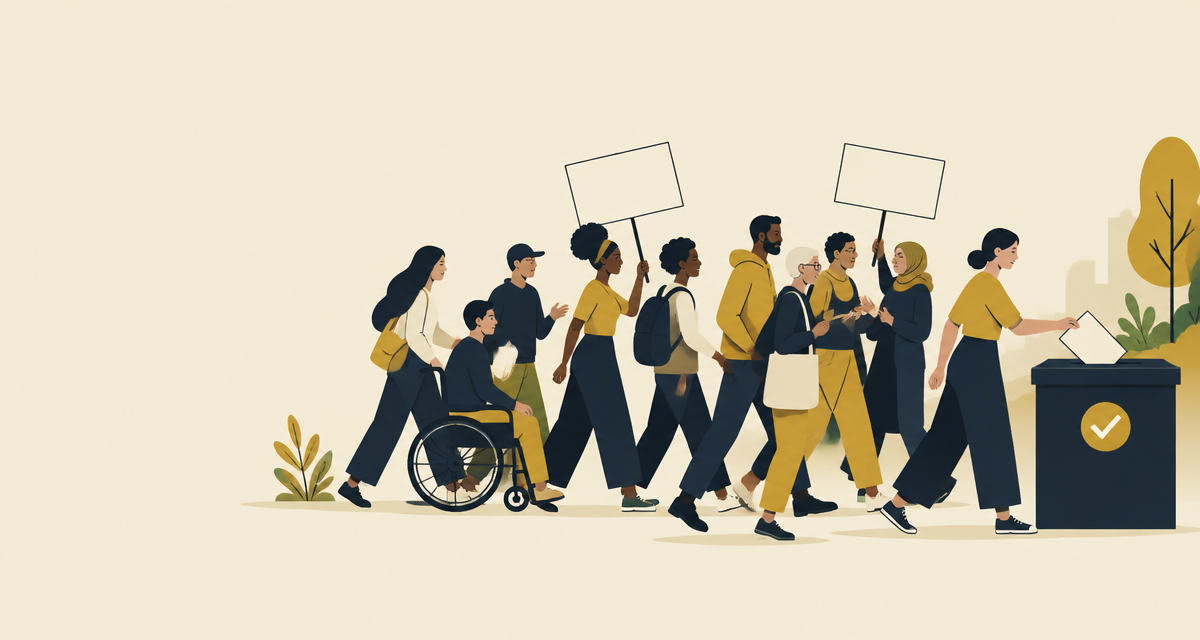
When politics feels broken, does voting still matter?
I often hear people say there is no point voting: the system is rigged, politicians do not represent us, and nothing ever changes. I understand the frustration behind those words. When promises are repeated but everyday problems remain, participation can begin to feel like an invitation to be disappointed again.
But I think there is a bigger question we need to ask ourselves: if we want change, what are we prepared to do to help bring it about?
This is not an argument that every political system is fair, or that casting a vote solves everything. It is a reflection on civic engagement: the different ways we can contribute to public life, challenge injustice and improve the communities we share.
Is the system rigged? Ask what that actually means
The word ‘rigged’ can describe very different concerns. Someone might mean that wealthy interests have too much influence, that the electoral rules feel unfair, that choices are too limited, or that an election has been manipulated. These are not interchangeable claims, and each needs its own evidence.
A useful starting point is to name the specific problem. Who made the decision? What rule allowed it? What information supports the claim? Who has the power to change it? A precise criticism gives us something to investigate and challenge. A general feeling that everything is hopeless can leave us with nowhere to begin.
Scepticism can be healthy. It becomes more useful when it leads to careful questions rather than an assumption that every possible action is meaningless. That is part of the power of asking better questions: moving from frustration towards understanding.
Voting is one form of participation—not the whole of it
A vote is a way to express a preference among the choices available in an election. It is not a guarantee that your preferred candidate will win, that every promise will be honoured, or that institutions will suddenly become fairer. Equally, disappointment with those limits does not automatically make voting worthless.
Voting and challenging the system do not have to be opposites. You can take part in an election while calling for reform, questioning representatives and organising around issues that remain unresolved. Participation need not mean approval of everything that exists.
Nor does public responsibility begin and end at the ballot box. The person helping a neighbour, supporting a charity or bringing people together to resolve conflict is also contributing to the kind of society we live in.
Practical ways to create change beyond voting
You can act locally, nationally or globally. What is realistic will depend on your circumstances, time, health and resources. There is no single correct way to contribute, and not everyone can take on the same commitments.
- Support a cause: volunteer your time, offer a useful skill or support a charity whose work you have checked.
- Make your voice heard: sign a relevant petition, write to a representative or attend a public meeting with a clear question.
- Share reliable information: check sources and context before sharing a claim, and correct mistakes when you discover them.
- Organise peacefully: join a lawful peaceful protest, distribute accurate leaflets or help a local group explain an issue.
- Strengthen your community: help young people, support a neighbour or bring people together around a shared problem.
- Hold representatives accountable: ask what they have done, request a response and follow up on commitments.
If you are unsure where to begin, explore causes that matter. If an unmet need keeps catching your attention, you might also consider creating your own community initiative. Start by listening to the people affected, rather than assuming you already know what they need.
Disagreement does not have to become division
People who want a better society will not always agree about how to build one. That does not make every disagreement a battle between good people and bad people. We can challenge a claim, policy or decision without denying another person’s dignity.
Listening does not require surrendering your convictions. It means making room to understand the concern beneath someone else’s position. Learning to disagree without creating division can help us identify shared goals and work together where cooperation is possible.
Choose one meaningful action—and follow through
No single action guarantees success. A petition may not change a decision. A meeting may end without agreement. A community project may need to adapt. But change can involve people raising awareness, organising, building support and taking action together over time.
Choose one issue that matters to you. Learn enough to understand it, find out who is already working on it, and select one manageable action. Then ask what happened: did someone receive help, did you gain useful information, did a decision-maker respond, or is a different approach needed?
This is not about blaming people who are exhausted or already struggling. Sometimes looking after yourself or those closest to you is the contribution you can make. The point is not to demand that everyone do everything. It is to recognise that meaningful participation can take more than one form.
You do not have to believe the system is perfect to participate in changing it. You do not have to be a politician to make a contribution. And you do not have to change the whole world to make a difference to someone’s life.
The question is not whether every action will succeed. The question is whether there is something within our reach that we are willing to try.
What matters to you—and what are you doing about it?
Explore more reflections on power, responsibility and shared humanity in the Cornerstones collection.