Who Creates the Money We Live By?
Most people think banks lend out money deposited by savers. But commercial banks also create new deposit money when they lend. Understanding this process raises a bigger question: where does that credit go, and what does it enable society to become?
If we're serious about human flourishing, eventually we have to talk about something that affects almost everything.
The economic system itself.
Money influences where we live, the businesses we can build, the opportunities available to us and the choices we make about our futures. It affects whether someone can buy a home, finance an idea, expand a business or recover from a difficult period in their life.
Yet many people have only a limited understanding of how money enters the economy in the first place. Most people think of money as something governments create and banks simply store and lend. But modern banking is more complicated.
Commercial banks create new deposit money when they make loans.
The Bank of England has explained this process in detail. When a commercial bank grants a loan, it generally creates a corresponding deposit in the borrower's account. The bank does not simply take an existing customer's savings and pass them to the borrower. Read the Bank of England's explanation.
That is an important distinction. But it leads to a much bigger question.
Who gets to decide where newly created credit goes?
And what consequences does that decision have for the society we live in?
How Is Money Created?
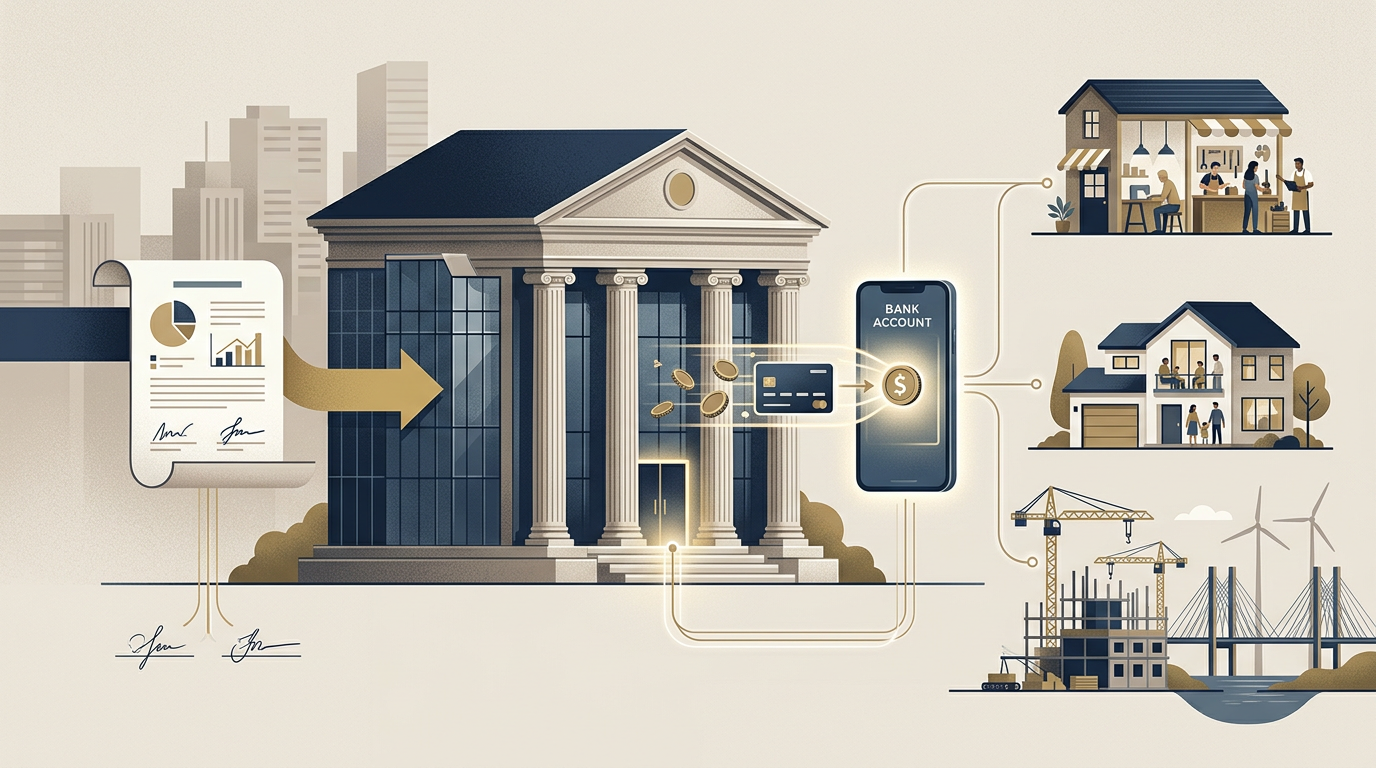
To understand the question of where credit goes, we first need to understand how money is created. In the United Kingdom, money exists in several forms, including banknotes and coins, commercial bank deposits and central bank reserves. Most of the money used by households and businesses is held as deposits in commercial bank accounts.
When a bank approves a loan, it normally records the loan as an asset on its balance sheet and credits the borrower's account with a matching deposit. That deposit can then be used to make payments. New deposit money has been created.
When the borrower repays the principal, the corresponding deposit money is reduced or destroyed through the repayment process. Interest payments have a different accounting treatment and are not simply the reverse creation of the original loan. The Bank of England explains this here.
This is why the idea that banks merely lend out money deposited by savers does not fully describe modern banking.
But there is an important qualification. Banks cannot create unlimited money without constraints. Their lending is influenced by the demand for credit, borrowers' ability to repay, profitability, capital and liquidity requirements, financial regulation, competition and monetary policy.
Money creation is therefore not the same as creating unlimited purchasing power without consequences. Nor is it the same as creating real wealth. A bank can create a deposit through lending, but that does not automatically create a new house, a productive business, additional skills or more goods and services. Those things depend on what people do with the financing and on the resources available to the economy.
That distinction takes us to the more important question. If bank lending creates much of the money we use, what determines where that money goes?
The Credit Creation Debate: Richard Werner's Argument

One researcher who has spent years examining how banks create money is Richard Werner, an economist known for his work on credit creation and the relationship between bank lending and economic activity.
In a 2014 paper published in the International Review of Financial Analysis, Werner examined competing theories of banking and presented empirical evidence supporting the view that individual commercial banks create money when they extend credit. Read the paper.
The basic point that commercial banks create deposit money through lending is also explained by the Bank of England. Werner's wider contribution concerns what the creation and allocation of credit mean for the economy.
His argument is that where credit goes matters enormously, not simply how much credit exists.
Consider two hypothetical uses of newly created bank credit. One business borrows to purchase equipment, develop a product, employ workers or expand its productive capacity. Another borrower obtains credit to purchase an existing financial asset, such as a property or a share.
Both transactions can have legitimate economic purposes. Buying an existing property, for example, may provide someone with a home, while financial markets can help businesses obtain investment and distribute risk. But the transactions can have different consequences for economic activity, asset prices and the distribution of wealth.
Financing the creation of new productive capacity can support the supply of goods and services. Credit used to purchase existing assets can increase demand for those assets and contribute to rising prices, particularly when lending expands rapidly relative to the supply of available assets.
Werner's research distinguishes between different uses of credit and examines how they may affect output, consumer prices, asset prices and financial stability. The strength and generality of particular conclusions remain matters for economic analysis and debate.
You do not have to agree with every aspect of his interpretation to recognise the importance of the underlying question. What kinds of activity does the financial system make easier to finance, and what kinds does it make harder?
Does Credit Flow Towards Productive Activity?
Imagine an economy in which people have ideas for new businesses, communities need better infrastructure and entrepreneurs want to develop products that solve genuine problems. For those ideas to become reality, people often need access to finance. They may need equipment, premises, stock, technology, staff or working capital while they wait to be paid by customers.
Credit can help make that possible. It can also finance housing, education-related investment, research and other activities that contribute to people's lives and the wider economy.
But the availability of credit does not automatically reflect the long-term social value of an activity. Banks make lending decisions within a commercial and regulatory environment. They assess risk, expected returns, collateral, repayment capacity and other factors.
An activity with strong potential social benefits may not necessarily be an attractive lending proposition for a particular bank. Conversely, an asset-backed loan may appear attractive because the lender can take security over an existing asset. These incentives matter, but they do not mean banks always favour property over productive businesses, or that lending for existing assets is inherently harmful. The outcome depends on the borrower, the market, the type of finance and wider economic conditions.
The important issue is whether the financial system provides a reasonable range of opportunities for viable businesses and productive investment while managing risks to borrowers and the wider economy.
Credit can support productive investment
Finance can help businesses purchase machinery, develop new technology, employ people and expand their operations. It can also help established businesses manage cash flow, invest in productivity and survive temporary disruptions. For smaller businesses, access to appropriate finance can influence whether an idea remains an idea or becomes a functioning enterprise.
Credit can support housing
Mortgages allow many households to purchase homes without first saving the entire purchase price. Finance can also support the construction and renovation of housing. However, credit is only one part of the housing equation. Planning, land availability, construction capacity, infrastructure, interest rates, incomes and government policy also influence affordability and supply.
An expansion of mortgage lending does not necessarily produce an equivalent expansion in the number of homes available. Where demand increases faster than supply, additional purchasing power can put upward pressure on prices.
Credit can contribute to financial instability
Borrowing can support investment and help households manage expenditure over time. But rapid credit expansion can also create vulnerabilities when debt grows faster than borrowers' ability to repay or when asset prices depend heavily on continued borrowing. If prices fall, highly indebted households and businesses can face difficulties. Lenders may suffer losses, and reduced lending can intensify an economic downturn. The Bank of England's Financial Stability Report examines these relationships.
The lesson is not that credit is good or bad in itself. It is that the purpose, terms, scale and consequences of lending all matter.
What Happens When Credit Fuels Existing Asset Prices?

Property offers a useful example because it connects the financial system to something most people understand from everyday life. A home is both a place to live and, for many households, their largest financial asset.
Access to mortgage credit can help people buy homes. But when more buyers can borrow, the effect on prices depends partly on how quickly the supply of housing can respond. If demand increases while supply remains constrained, prices may rise. Existing property owners may benefit from rising asset values, while people trying to buy their first home can find that the deposit and income required become harder to achieve.
This does not mean that banks alone determine house prices. Interest rates, incomes, planning rules, land values, population changes, construction costs and expectations all play a role. Nor does it mean that every increase in property values is caused by credit creation.
The point is more specific. The way finance interacts with the supply of real assets can influence who benefits from economic activity and who faces greater barriers to entry.
The same broad question applies to other asset markets, although the mechanisms and consequences differ. This is one reason economists examine not only the amount of credit in an economy but also its destination and its relationship with income, output and asset prices. If a financial system makes it easier to borrow against assets that are already expensive than to finance a viable new enterprise, it is reasonable to investigate whether that pattern creates unintended consequences.
But the evidence must establish whether such a pattern exists in a particular market, how significant it is and what is causing it. A serious examination of the financial system should not begin with a predetermined villain. It should begin with a question that can be investigated.
Does the Financial System Reward the Right Things?
Let's take a step back. The question is not whether banks should exist or whether credit should be available. Modern economies need ways to make payments, assess risk, finance investment, manage savings and support businesses and households. Banks perform essential functions within that system.
The question is whether the incentives and institutions surrounding finance consistently support the outcomes society needs. Does the system help viable businesses access appropriate finance? Does it support innovation and investment? Does it allow people to finance homes without creating unsustainable debt? Does it manage risk responsibly? Does it help the economy respond to shocks? And does it provide opportunities across a broad range of people and places?
These are questions about outcomes, not simply ideology. They also require us to look beyond the decisions of individual banks. Credit allocation is influenced by many factors, including central bank interest rates, government policy, financial regulation, taxation, the availability of collateral, the expected returns on investment and the wider economic environment.
Changing one part of the system can have consequences elsewhere. A policy designed to expand access to credit, for example, may help some borrowers but create new risks if lending standards weaken or the supply of assets cannot respond. A policy designed to reduce financial risk may improve resilience but also needs to be assessed for its effects on the cost and availability of finance. There are trade-offs to examine.
The objective should be to understand those trade-offs rather than assume that one simple change will solve a complex system.
Could We Design a Better Relationship Between Money and Society?

Once we understand how money and credit work, we can ask a more constructive question. Can we design a better relationship between money, credit, banking, government, business and society?
That question does not have one obvious answer. But there are several areas worth investigating.
1. How can viable businesses access appropriate finance?
Smaller businesses may have limited collateral, short trading histories or irregular cash flow. Those characteristics can make lending more difficult, even when a business has a credible opportunity. It is worth examining how traditional bank lending, community finance, credit unions, government-backed schemes and other financing models serve different types of businesses. The relevant question is not whether every business should receive a loan. It is whether viable opportunities are being overlooked and, if so, why.
2. How can finance support productive investment?
Investment in equipment, technology, skills, research and infrastructure can contribute to future productive capacity. But productive investment involves risk. Some projects fail, and some investments take years to generate returns. The challenge is to create conditions in which worthwhile projects can obtain finance without encouraging reckless lending or assuming that every investment labelled productive will succeed.
3. What role should alternative banking models play?
Different banking and finance models operate under different structures, incentives and ownership arrangements. Examples include credit unions, cooperative finance, community development finance institutions and specialist business lenders. These models may serve particular communities or types of borrower that are less well served by conventional products. However, alternative ownership or governance does not automatically guarantee better outcomes. Each model needs to be assessed on its accessibility, costs, sustainability, governance and actual results.
4. What role should government play?
Governments influence the financial system through regulation, taxation, public investment, guarantees and other policy decisions. They can also affect the wider conditions in which businesses borrow and invest. But public intervention involves choices about cost, accountability, risk and competing priorities. Poorly designed programmes can waste resources or direct finance towards activities that do not deliver their intended benefits. The question is not simply whether government should intervene. It is where intervention might address a clearly identified problem, what evidence supports it and how its outcomes would be measured.
5. Should we explore new financial models?
Possibly. New models may offer useful ways to organise investment, share risk or improve access to finance. But novelty is not proof of effectiveness. Any proposed model should be examined for its assumptions, incentives, resilience, governance and consequences for the people expected to use it. The aim should not be to replace one unquestioned system with another. It should be to remain willing to investigate alternatives and compare them honestly.
The Rat Race Is Not Only About Individual Choices
At Get Out Rat Race, we talk about taking responsibility for our lives. Developing skills matters. Building businesses matters. Understanding money matters. Finding ways to turn knowledge, experience and passion into something valuable can create opportunities that might otherwise remain out of reach.
But individual effort takes place within wider economic conditions. A person can work hard, become more entrepreneurial and make sensible decisions while still facing barriers arising from housing costs, access to finance, economic instability or circumstances beyond their immediate control.
Recognising this does not remove personal responsibility. Equally, emphasising personal responsibility should not prevent us from examining the systems that shape people's opportunities. Both things can be true. People can make better choices, and institutions can be improved. Entrepreneurship can create opportunities, and the availability of appropriate finance can influence which entrepreneurial ideas become viable. Markets can coordinate economic activity, and their rules and incentives can be examined. Banks can perform essential functions, and their lending decisions can have wider consequences.
The aim is not to blame one group for every economic problem. It is to understand the relationship between individual action and the environment in which that action takes place. The rat race is not simply a problem of how people behave. It is also a question about the conditions in which people are trying to build their lives.
What Should We Measure an Economy By?
Gross domestic product, employment, inflation, productivity, investment and other economic indicators help us understand important aspects of an economy. They tell us things about output, prices, work and economic activity. But no single indicator captures everything that matters to human beings.
Economic growth can expand opportunities, support public services and improve living standards. Yet its effects depend on what is produced, how the benefits are distributed, the costs involved and whether the gains can be sustained. Likewise, a rise in lending is not automatically evidence of economic progress. It matters whether borrowing supports useful activity, whether debt remains manageable and what happens when circumstances change.
This is not an argument against measuring economic performance. It is an argument for examining several dimensions together. Does the economy support productive work? Can people develop useful skills? Are viable businesses able to grow? Can households obtain suitable housing? Does investment support future capacity? Can people withstand economic shocks? Are the opportunities available today helping future generations build secure and meaningful lives?
These questions connect economic analysis to the broader idea of human flourishing. They do not replace technical economic measures. They help us ask what those measures mean for people's lives.
The Question We Should Be Willing to Ask
I don't know the final answer to how our financial system should be designed. And that is precisely why the question deserves investigation. We should be willing to examine how money is created, how credit is allocated, which incentives shape financial decisions and what consequences follow.
We should be prepared to study evidence, challenge established assumptions and compare different models without assuming that every alternative is better than the existing system. Perhaps some forms of investment deserve greater attention. Perhaps some barriers to finance could be reduced. Perhaps certain policies create unintended consequences that should be addressed. Perhaps some existing institutions work better than their critics acknowledge, while others need reform.
The answers should come from evidence and careful evaluation, not loyalty to an economic ideology. Because the ultimate question is not simply how much money an economy creates. It is what that economy enables people to do.
Can people build businesses, develop their talents, support their families, create useful things and contribute to their communities? Can they pursue meaningful work without being trapped by unnecessary barriers? Can the financial system support opportunity while remaining stable enough to serve future generations?
These are not questions that can be answered by money creation alone. But understanding how money is created is an important part of asking them. Perhaps the ultimate measure of an economy is not simply how much money it creates, but what that economy allows human beings to become.
And if we discover that parts of the system could work better, we should have the courage to explore something better.
The Rat Race Ends Within.
Become Who You Were Born To Be.
Trusted Sources and Further Reading
- Bank of England — Money Creation in the Modern Economy
- Bank of England — How Is Money Created?
- Richard A. Werner — Can Banks Individually Create Money Out of Nothing? (2014)
- Bank of England — Financial Stability Report, July 2026
- Bank of England — Banks Are Not Intermediaries of Loanable Funds (2015)
Continue Exploring
Frequently Asked Questions
Who creates money in the UK?+
Do commercial banks create money when they lend?+
Does the Bank of England create all the money in circulation?+
What does Richard Werner argue about money creation?+
Does bank lending cause house prices to rise?+
Is money creation the same as creating wealth?+
Should banks lend more to productive businesses and less to property?+
How does the financial system affect human flourishing?+
The History of the Rat Race: How Did We Get Here?
Where did the rat race come from? Explore the 200-year story of work, productivity, consumption and identity.
PurposeHow to Find Your Passion: Your Passion Might Be More Valuable Than You Think
What if the things you are naturally drawn to are giving you clues about what you could build?
PurposeWhat Does It Mean to Live Well? Understanding Human Flourishing
What does it truly mean to flourish as a human being? Explore eudaimonia, purpose and the good life.
This article was developed with assistance from AI tools. AI was used to help with research, organisation and/or drafting. The content was reviewed and edited before publication, and responsibility for the final article rests with Get Out Rat Race.
Find Your Spark™
You've been exploring the ideas. Now explore yourself.
The Free Spark Score is a simple starting point to help you reflect on your interests, experiences, strengths and what might genuinely matter to you.