Visiting CERN: The Search for Reality and the Limits of What We Know
Introduction: Why I Wanted to Visit CERN
I recently took the opportunity to visit CERN, near Geneva, Switzerland.
For me, the attraction was about more than visiting an internationally recognised scientific institution. I wanted to explore one of humanity's most ambitious attempts to investigate the fundamental structure of the universe.
What is reality actually made of? What are the smallest building blocks of matter? How much do we genuinely understand about the universe we inhabit? And perhaps just as importantly, how much remains beyond our current knowledge?
These are enormous questions. They sit at the intersection of science, philosophy and our understanding of existence itself.
CERN is particularly interesting because it represents humanity's attempt to investigate some of these questions through experimentation. Rather than relying on intuition, speculation or philosophical argument alone, scientists construct enormous instruments, develop mathematical theories and test their predictions against the physical world.
That process is something I find particularly relevant to Get Out Rat Race.
Our philosophy is not simply about changing careers, creating businesses or achieving greater financial independence. It is also about developing ourselves intellectually, questioning inherited assumptions, exploring new ideas and becoming more conscious of the world around us.
I wanted to understand more about what CERN has discovered, what its experiments are designed to investigate, and what scientists still cannot explain.
I wasn't visiting as a physicist, nor do I claim scientific expertise. I went because I was curious.
CERN is the European Organization for Nuclear Research. It is one of the world's leading centres for fundamental physics research.
Located near Geneva, on the border between Switzerland and France, CERN brings together scientists, engineers, technicians and researchers from around the world.
Its purpose is to investigate the fundamental structure of matter and the forces that govern the universe.
To understand why CERN exists, it helps to consider a basic question:
What is everything around us actually made of?
For much of human history, people understood matter through everyday experience. We could see, touch and manipulate objects, but the microscopic structure of the physical world remained hidden.
Over time, scientific developments revealed that ordinary matter is made from atoms. Atoms themselves contain smaller components: protons, neutrons and electrons. Protons and neutrons are made from even smaller particles called quarks.
Modern particle physics investigates this increasingly fundamental level of nature.
CERN was established to advance this understanding through international scientific collaboration and experimental research.
One of its most important instruments is the Large Hadron Collider, commonly known as the LHC.
Why build such an enormous machine?
Scientists cannot simply look inside a proton with an ordinary microscope.
To investigate extremely small scales, they use high-energy particle collisions. By accelerating particles to enormous energies and analysing what happens when they collide, researchers can investigate the behaviour of fundamental particles and test predictions made by physics theories.
The higher the collision energy, the more possibilities scientists can investigate.
This is one of the reasons the LHC is such an extraordinary scientific achievement.
2. The Large Hadron Collider: Investigating the Building Blocks of Matter
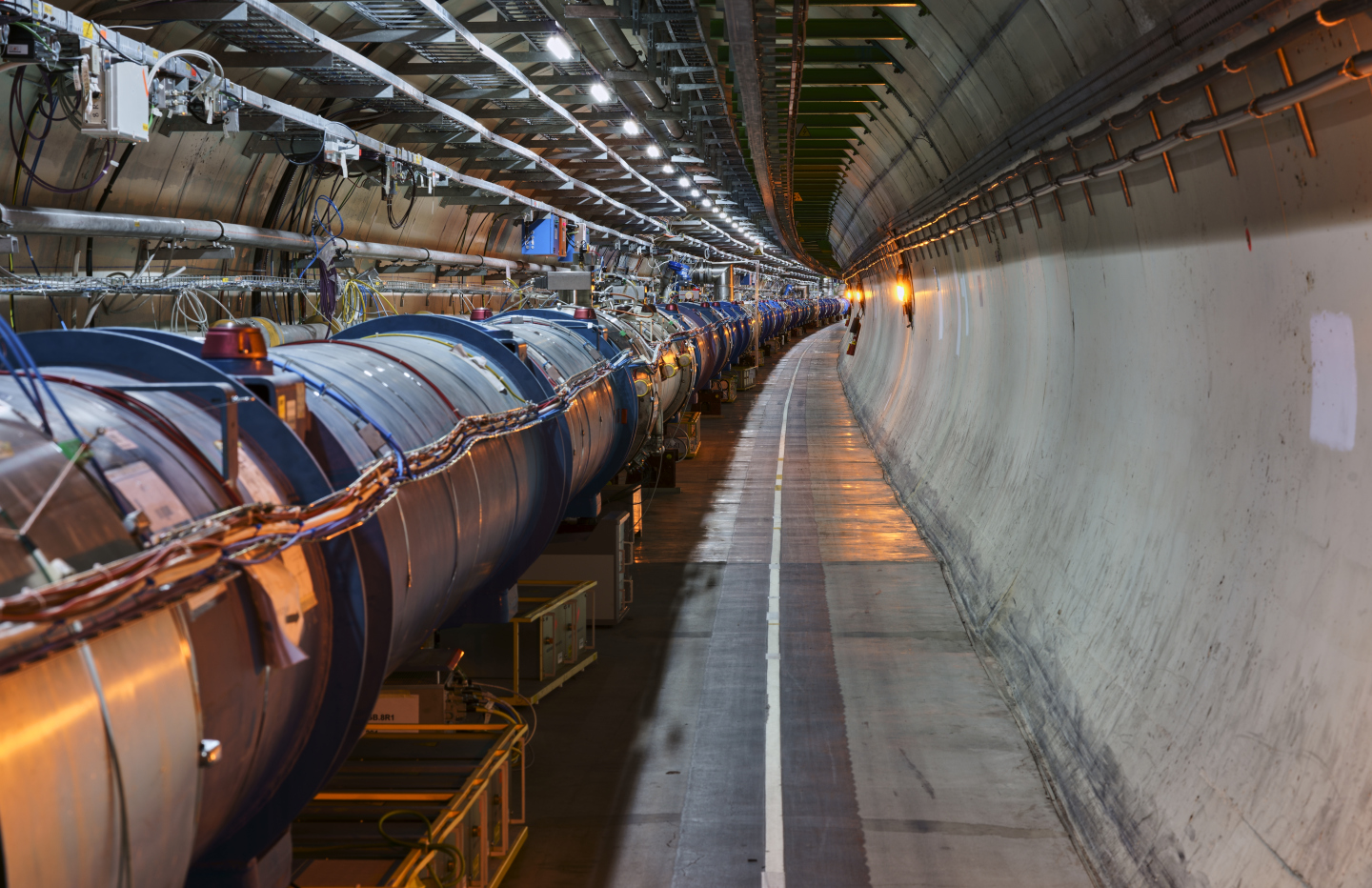
The Large Hadron Collider is an enormous particle accelerator located in an underground circular tunnel approximately 27 kilometres in circumference.
It accelerates beams of particles, principally protons in its proton–proton programme, in opposite directions around the ring.
These beams are brought into collision at particular points where enormous detectors record the resulting interactions.
The process is extraordinarily complex.
When particles collide at sufficiently high energies, their energy can produce other particles. Scientists examine the resulting signals and compare them with theoretical predictions.
The objective is not simply to smash particles together. It is to create conditions in which the fundamental laws of nature can be investigated.
What are scientists looking for?
The LHC has several important research objectives:
Testing the Standard Model of particle physics.
Studying the Higgs boson and the Higgs field.
Investigating matter under extreme temperatures and densities.
Studying rare particle decays and unusual interactions.
Searching for evidence of particles or phenomena not explained by current theories.
One particularly important objective is to investigate where existing scientific explanations work exceptionally well and where they may be incomplete.
That distinction matters.
A scientific theory can explain an enormous amount about the natural world without necessarily providing a complete description of everything.
The LHC is one of the instruments helping scientists investigate those boundaries.
The importance of the experiments
The LHC operates through several major experiments, including ATLAS and CMS.
These are enormous particle detectors designed to record different aspects of the collisions.
The detectors generate vast quantities of information. Scientists then use sophisticated computational methods to identify patterns and determine whether the results support existing predictions or suggest something new.
It is a remarkable example of international cooperation, advanced engineering and human curiosity working together.
3. The Higgs Boson: One of Physics' Major Discoveries
One of CERN's most recognised achievements was the discovery of a new particle consistent with the Higgs boson, announced in July 2012 by the ATLAS and CMS collaborations.
This was a major milestone in modern physics.
But what exactly is the Higgs boson?
To understand its significance, we need to introduce the Higgs field.
The Higgs field is a fundamental field that exists throughout space. Through its interaction with the field, certain elementary particles acquire mass.
The Higgs boson is an excitation of this field.
A useful distinction is that the Higgs boson and the Higgs field are related, but they are not the same thing.
The discovery provided strong experimental confirmation of an important part of the Standard Model and the Brout–Englert–Higgs mechanism.
Does the Higgs boson explain all mass?
No. This is an important distinction.
It is sometimes suggested that the Higgs boson explains where all mass in the universe comes from. That is an oversimplification.
The Higgs mechanism explains the masses of elementary particles such as electrons and quarks through their interaction with the Higgs field.
However, most of the mass of familiar protons and neutrons comes from the energy associated with the strong interaction binding their constituent quarks and gluons.
This illustrates something important about scientific discoveries.
A discovery can answer a major question while revealing how much more there is to understand.
The Higgs boson was not the discovery of the origin of everything. It was a major step forward in understanding the fundamental structure of matter.
Perhaps one of the most interesting aspects of studying CERN is recognising how much remains unresolved.
The Standard Model is one of the most successful scientific frameworks ever developed. It describes known elementary particles and three fundamental interactions: the electromagnetic, weak and strong interactions.
It has survived an extraordinary number of experimental tests.
Yet it is not a complete theory of nature.
There are major questions that current physics cannot fully answer.
Dark matter
Astronomical observations provide strong evidence that the universe contains more gravitating matter than we can account for through the matter we observe directly.
Scientists call this missing component dark matter.
Its gravitational effects can be observed through the behaviour of galaxies and other astronomical systems.
However, its fundamental nature remains unknown.
Scientists have proposed various possible explanations, including hypothetical particles, but no dark matter particle has been conclusively identified.
Matter and antimatter
According to our current understanding, matter and antimatter should have been produced in closely related quantities during the early universe.
Yet the observable universe contains far more matter than antimatter.
Why did this imbalance develop?
The known physics does not fully explain the matter–antimatter asymmetry we observe.
It is one of the major unanswered questions in fundamental physics.
Neutrino masses
Neutrinos are extremely difficult-to-detect elementary particles that interact very weakly with matter.
Experiments have established that neutrinos have mass, which means the simplest version of the Standard Model needs to be extended or modified to account for this.
Quantum gravity
Another major challenge concerns the relationship between quantum mechanics and gravity.
General relativity describes gravity and the structure of spacetime on large scales.
Quantum theory describes the microscopic behaviour of physical systems.
Both frameworks have achieved remarkable success within their respective domains.
However, scientists do not yet have a complete, experimentally confirmed theory that unifies gravity with quantum physics.
What does this tell us?
It is tempting to assume that because science has made such extraordinary progress, it must eventually have an answer to everything.
But that is not something we can simply assume.
The more we discover, the more sophisticated our questions can become.
And that is not a weakness of science.
It is part of what makes scientific investigation valuable.
A scientific experiment does not have to discover something new to be useful. A result that fails to confirm a prediction can narrow the possibilities and help researchers understand which explanations are less likely.
The honest position is neither that science knows everything nor that science knows nothing. It is that scientific knowledge is powerful, continually tested and incomplete.
Dark matter evidence: The blue overlay maps inferred mass; it is not visible light emitted by dark matter. X-ray: NASA/CXC/CfA/M. Markevitch; optical and lensing: NASA/STScI, Magellan/U. Arizona/D. Clowe; lensing: ESO WFI. (1 of 4)
5. Quantum Physics and the Nature of Reality
This is where the subject becomes particularly fascinating.
Quantum mechanics is the scientific framework used to describe the behaviour of physical systems at very small scales, including atoms, electrons and photons.
Quantum field theory extends this framework and forms the basis of the modern description of elementary particles and their interactions.
One of the more interesting ideas is that particles are not necessarily best understood as tiny solid objects moving through otherwise empty space.
In quantum field theory, particles are described as excitations of underlying fields.
For example:
The electron is associated with the electron field.
The photon is associated with the electromagnetic field.
The Higgs boson is associated with the Higgs field.
This is a much more sophisticated description of the physical world than our everyday intuition might suggest.
Why quantum physics challenges our intuition
At everyday scales, we experience objects as having reasonably definite positions and properties.
However, at quantum scales, physical systems behave in ways that cannot always be described using the familiar assumptions of classical physics.
Some of the important concepts include:
Superposition: Quantum systems can be described as combinations of possible states before a particular measurement is made.
Uncertainty: Certain pairs of physical properties, such as position and momentum, cannot both be known with unlimited precision.
Quantum measurement: The process of measurement plays a specific role in the mathematical description and experimental predictions of quantum theory.
These concepts are technically precise. They should not be casually translated into claims that human thoughts directly create physical reality.
Does quantum physics prove that consciousness creates reality?
No.
This is an important distinction, particularly because quantum physics is frequently used in popular discussions about consciousness, spirituality and manifestation.
There are genuine philosophical questions about the meaning of quantum mechanics and what its mathematical framework tells us about physical reality.
There are also different interpretations of quantum mechanics.
However, CERN's experiments do not demonstrate that human consciousness creates the universe, that thoughts directly control external events or that manifestation is validated by quantum physics.
The word observer in quantum physics does not automatically mean a conscious human being watching something happen.
In physics, measurement has a technical meaning involving interactions between physical systems and measuring apparatus.
That does not make the philosophical questions uninteresting.
It simply means we should be careful about what the science actually establishes.
Four different levels of understanding
When exploring subjects like quantum physics, it is useful to separate four categories:
Established science: Results and theories that have survived extensive experimental testing within defined limits.
Open scientific questions: Areas where existing explanations are incomplete or where further experiments are required.
Philosophical interpretation: Questions about what scientific theories mean for our understanding of existence, reality and knowledge.
Speculation: Interesting possibilities that have not yet gained sufficient evidence to be presented as established fact.
I think this distinction is important because it allows us to remain curious without becoming credulous.
We do not need to pretend that every question has been answered. Equally, we should not treat every attractive explanation as equally credible.
What is reality, ultimately?
CERN can investigate the behaviour of particles, fields and fundamental interactions.
Quantum field theory can provide powerful mathematical descriptions of how these systems behave.
But the deeper philosophical question of what reality ultimately is remains open to interpretation and ongoing investigation.
A scientific description of how physical systems behave is not automatically a final metaphysical explanation of why anything exists.
That is where scientific inquiry and philosophy can have a meaningful conversation without pretending they are the same discipline.
Fields and excitations: Particles can be described as field excitations; this is a visual analogy. AI-generated conceptual illustration, not experimental evidence; not to scale. (1 of 3)
6. The Future Circular Collider: What Comes Next?
CERN's research does not stop with the Large Hadron Collider.
One of the most ambitious proposals for the future of particle physics is the Future Circular Collider, usually referred to as the FCC.
The proposal explores a new underground ring approximately 91 kilometres in circumference.
For comparison, the existing Large Hadron Collider has a circumference of approximately 27 kilometres.
The FCC is not simply intended to be a larger version of the LHC. Its proposed programme includes different stages with different scientific objectives.
FCC-ee: precision first
The first proposed stage is an electron–positron collider.
Its purpose would be to conduct extremely precise measurements of fundamental particles and interactions.
This could help scientists:
Study the Higgs boson and its properties in greater detail.
Investigate important particles and processes with exceptional precision.
Search for small deviations from Standard Model predictions.
Improve constraints on possible extensions to existing physics.
The importance of precision is worth understanding.
Sometimes the next major scientific breakthrough does not come from finding an entirely new particle. It comes from measuring something so accurately that a small discrepancy reveals that an existing theory is incomplete.
FCC-hh: pushing the energy frontier
A later possible stage would involve a proton–proton collider.
This would explore much higher collision energies, with a design ambition of up to approximately 100 TeV centre-of-mass energy.
Such a machine could investigate heavier particles and phenomena that are beyond the reach of current accelerators.
However, it is important to be clear: this is a proposed future programme, not a guarantee that particular discoveries will be made.
Has the Future Circular Collider been approved?
No final construction decision has been made.
In the 2026 European Strategy for Particle Physics process, FCC-ee was recommended as the preferred option for CERN's next flagship collider project.
The decision on whether to proceed is expected by 2028.
The project still has to pass through scientific, technical, financial, environmental and political evaluation.
This is an important example of the difference between a scientific proposal, a strategic recommendation and an approved construction project.
Why build something even bigger?
The fundamental questions remain.
What is dark matter? Why is there more matter than antimatter? Is there a deeper structure beyond the particles we currently understand? Can our current theories be extended into a more complete description of nature?
A more powerful or precise instrument could help investigate these questions.
But it cannot guarantee the answers.
That is part of the excitement of scientific research: we can develop increasingly sophisticated ways to investigate nature without knowing exactly what we will find.
7. What CERN Can Teach Us About Knowledge and Independent Thinking
There is something about CERN that I find particularly relevant beyond the scientific discoveries themselves.
It represents a disciplined approach to curiosity.
Scientists develop theories, build instruments, test predictions, examine results and revise their understanding when the evidence requires it.
They do not simply accept an explanation because it is popular or because someone important has said it.
They investigate.
That process has a wider relevance to how we approach information and the world around us.
We live in a period where information is readily available. We can access opinions, news, documentaries, research papers and explanations about almost any subject.
But access to information is not the same as understanding.
We can consume enormous quantities of information without necessarily becoming better informed.
We can also become attached to an explanation because it supports what we already believe.
These questions are not about rejecting expertise.
In fact, understanding complex subjects requires us to recognise that we depend on people who have spent years developing specialist knowledge.
The challenge is to develop informed trust rather than blind acceptance or automatic suspicion.
Intellectual humility is not weakness
There is a difference between having no opinion and recognising the limits of what you know.
You can have a strong, evidence-based position while remaining open to new information.
You can recognise that a scientific consensus is well supported without assuming that every question has been settled.
You can question institutions without automatically assuming they are dishonest.
And you can explore unconventional ideas without treating them as established facts.
For me, that is one of the more valuable lessons that can be taken from studying a place like CERN.
The pursuit of knowledge requires both curiosity and discipline.
It requires us to be willing to question our assumptions while also being willing to accept what the evidence demonstrates.
Checking sources: Informed trust starts with evidence and context. AI-generated conceptual illustration, not experimental evidence; not to scale. (1 of 1)
8. The Bigger Questions: Reality, Consciousness and Existence
The more we investigate the universe, the more questions seem to emerge.
We can describe particles, fields and interactions with extraordinary mathematical precision.
We can investigate the behaviour of matter at scales that would have been almost unimaginable to previous generations.
But questions about the ultimate nature of reality remain.
What is existence? Why does anything exist at all? What is the relationship between the physical world and consciousness? How does subjective experience arise?
These questions belong to several overlapping areas of investigation, including physics, neuroscience, philosophy and the philosophy of mind.
It is important not to confuse them.
CERN's particle collision experiments are not designed to establish a theory of consciousness. Quantum mechanics does not provide a settled explanation of subjective experience.
But the limits of what we currently understand do leave room for legitimate philosophical questions.
The importance of not confusing possibility with proof
There is a temptation to move from a genuine scientific mystery to an explanation that feels profound.
For example, the fact that quantum mechanics challenges classical intuition does not mean that every spiritual or metaphysical interpretation of reality is scientifically supported.
Likewise, the fact that science has not answered every question does not mean that any alternative explanation is automatically credible.
There is a difference between acknowledging uncertainty and filling that uncertainty with whatever explanation we prefer.
I think this is one of the most important principles in exploring the nature of reality.
We should be open to possibilities, but our confidence should remain proportionate to the evidence.
Perhaps the most interesting question is what we have not yet considered
Scientific progress often requires people to question assumptions that once seemed obvious.
That does not mean every established idea is wrong.
It means our understanding can develop when better evidence, more powerful instruments and new ways of thinking become available.
The history of science demonstrates that our understanding of the universe has changed dramatically over time.
There is no reason to assume that our current picture represents the final word.
But there is also no reason to claim that an unknown answer has already been discovered.
Sometimes the most honest answer is that we do not yet know.
Examining our assumptions: Reflection on consciousness is not a particle-physics finding. AI-generated conceptual illustration, not experimental evidence; not to scale. (1 of 1)
9. Why This Connects With Get Out Rat Race
At first glance, visiting a particle physics laboratory might seem a long way from a project about self-development, entrepreneurship and building a more meaningful life.
But I see a connection.
Get Out Rat Race is built around the idea of becoming who you were born to be.
That involves more than financial success or changing the circumstances of your working life.
It involves understanding yourself, exploring your potential, questioning assumptions and developing the freedom to make more conscious decisions.
Curiosity is part of that process.
When we explore subjects beyond our immediate routines, we expand our understanding of the world.
When we question what we think we know, we become more aware of the influences shaping our beliefs.
When we recognise the limits of our knowledge, we become more open to learning.
And when we develop the confidence to investigate ideas independently, we become less dependent on simply accepting the opinions of others.
Intellectual freedom and personal freedom
There is a useful parallel between the two.
Personal freedom involves examining the assumptions, habits and circumstances that influence how we live.
Intellectual freedom involves examining the beliefs, information and interpretations that influence how we understand the world.
Both require curiosity.
Both require self-awareness.
Both require the willingness to reconsider what we previously accepted.
And both are part of becoming more fully conscious of the choices available to us.
My visit to CERN was one small part of that wider journey.
I went because I wanted to learn more about the universe, but I also came away with a reminder of something broader:
The pursuit of knowledge is not simply about collecting answers. It is also about learning how to ask better questions.
Get Out Rat Race — Become Who You Were Born To Be.
Beyond our routines: Exploration can broaden the questions we ask about our lives. AI-generated conceptual illustration, not experimental evidence; not to scale. (1 of 1)
10. Visiting CERN: My Personal Travel Recommendation
If you are considering visiting CERN yourself, it is worth thinking about accommodation in the surrounding area.
CERN is located close to the French–Swiss border, and there are accommodation options on the French side that may be worth considering.
During my visit, I stayed at Séjours & Affaires Saint Genis, an aparthotel in Saint-Genis-Pouilly, France.
I found it a lovely place to stay, and one of the things I particularly enjoyed was the walk between the accommodation and CERN, which took me approximately 30 minutes.
It was a pleasant way to experience the surrounding area rather than simply travelling between a hotel and the research centre.
The aparthotel offers furnished accommodation, including studios and larger apartments. The official website describes facilities such as equipped kitchens, Wi-Fi and a fitness room, with services such as breakfast and parking available at additional cost.
Based on the research I carried out when planning my visit, I also found it an affordable option compared with some of the alternatives in the area.
Of course, prices and availability can change, so I would recommend checking the current rates and the details of the accommodation before booking.
A transparency note: I am sharing this as a personal recommendation based on my own experience and research. I do not receive affiliate commission, payment or any other financial benefit if you visit the website or make a booking. I simply thought it was worth mentioning because I found it affordable and enjoyed staying there.
If you are planning a visit to CERN, it may be an option worth investigating.
CERN is the European Organization for Nuclear Research, an international scientific organisation near Geneva. It investigates the fundamental structure of matter and the forces governing the universe.
What is the Large Hadron Collider?
The Large Hadron Collider is a particle accelerator with a circumference of approximately 27 kilometres. It accelerates particles to extremely high energies and brings them into collision so scientists can investigate fundamental particles and physical interactions.
What did CERN discover in 2012?
The ATLAS and CMS collaborations announced the discovery of a new particle consistent with the Higgs boson in July 2012. Subsequent research has strengthened the identification and enabled detailed studies of its properties.
What does the Higgs boson do?
The Higgs boson is an excitation of the Higgs field. The field is associated with the mechanism through which certain elementary particles acquire mass. It does not explain all the mass of ordinary matter.
Does CERN know what dark matter is?
No. There is strong astronomical evidence for dark matter, but its fundamental nature and particle identity remain unknown.
Does quantum physics prove that consciousness creates reality?
No. Quantum mechanics raises important questions about measurement and the nature of physical reality, but CERN's experiments do not establish that human consciousness creates the universe or directly controls external events.
What is the Future Circular Collider?
The Future Circular Collider is a proposed next-generation particle physics facility at CERN. Its study explores a ring approximately 91 kilometres in circumference, with a proposed electron–positron stage followed by a possible proton–proton stage.
Has the Future Circular Collider been approved?
No final construction decision has been made. FCC-ee was recommended as the preferred option in the 2026 European Strategy for Particle Physics process. A decision on whether to proceed is expected by 2028.
Why is CERN important?
CERN allows scientists to investigate fundamental questions about matter, particles and the forces of nature. Its research tests scientific theories, improves our understanding of the universe and can reveal where current explanations are incomplete.
Can I visit CERN?
CERN offers visitor experiences and public engagement opportunities, but availability and access arrangements can vary. Check CERN's official visitor information before travelling.
Where can I stay when visiting CERN?
There are accommodation options in the surrounding area, including Saint-Genis-Pouilly in France. I personally stayed at Séjours & Affaires Saint Genis and found it affordable based on the research I carried out at the time. I also enjoyed the walk to CERN, which took me approximately 30 minutes.
12. Trusted Sources and Further Reading
The following sources provide the scientific foundation for this article. CERN's own resources are particularly useful for understanding the experiments and proposed future facilities. Independent scientific and educational sources provide additional context.
Particle Data Group — Review of Particle Physics https://pdg.lbl.gov/ A major reference resource compiling experimental and theoretical information about particle physics.
Stanford Encyclopedia of Philosophy — Quantum Mechanics https://plato.stanford.edu/entries/qm/ A detailed philosophical and conceptual introduction to quantum mechanics and its interpretations.
These sources support the scientific explanations in this article. They do not establish every philosophical interpretation discussed here.
The distinction between scientific evidence, open questions and philosophical reflection is intentional. Quantum physics should not be used to support claims about consciousness, manifestation or spirituality unless the specific claim has independent evidence.
Keep asking better questions
The more we investigate the universe, the more we discover how much there is still to understand.
CERN represents one of humanity's most ambitious attempts to investigate the foundations of physical reality. Its discoveries are extraordinary, but perhaps just as interesting are the questions that remain unanswered.
For me, the visit was a reminder that learning is not simply about finding answers that confirm what we already believe.
It is about remaining curious, challenging assumptions, exploring new perspectives and being prepared to change our understanding when the evidence requires it.
We should be confident where the evidence is strong, honest where knowledge is incomplete and humble enough to keep asking questions.
Because becoming who we were born to be is not just about what we achieve.
It is also about how we think, what we explore and how consciously we choose to live.
Get Out Rat Race — Become Who You Were Born To Be.
CERN photographs and diagrams are reproduced for educational and informational use under CERN’s audiovisual media terms. CERN retains copyright; their inclusion does not imply endorsement. The Bullet Cluster source is NASA’s dark matter overview, with full collaborator credits in its caption. Other images are explicitly labelled AI-generated concepts and are not evidence, precise simulations or photographs of my visit.