Introduction: the mystery behind everything we see
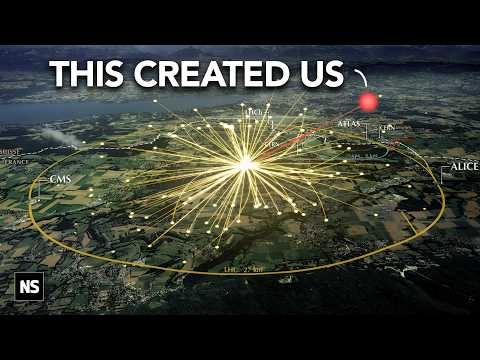
Our bodies, the air around us and distant stars are all made of matter. That sounds ordinary until we ask why any matter survived the early universe. In Why Our Existence Doesn’t Really Make Sense, New Scientist visits CERN’s Antimatter Factory to explore a puzzle at the heart of modern physics: why does the observable universe contain so much more matter than antimatter?
This article summarises the supplied video description in our own words. It is a story about careful experiments and unanswered questions—not a claim that scientists have already solved the origin of existence.
What is antimatter?
Antimatter consists of particles corresponding to ordinary matter particles, with the same mass but opposite electric charge where applicable. The positron, for example, is the electron’s positively charged counterpart. When a particle meets its antiparticle, they can annihilate, converting their energy into other particles.
Simple expectations for the hot early universe suggest that matter and antimatter would have been produced in equal amounts. If they had remained perfectly balanced, annihilation would have left very little of the matter needed to build stars, planets and people. Explaining the surviving excess is known as the matter–antimatter asymmetry problem.
Inside CERN’s Antimatter Factory
At CERN, researchers create and slow down antiprotons so that experiments can investigate their properties. Some experiments combine them with positrons to produce antihydrogen, the antimatter counterpart of hydrogen.
Studying these particles is difficult. Ordinary laboratory surroundings are made of matter, so antimatter cannot simply be placed in a conventional container. Special electromagnetic traps and tightly controlled conditions allow researchers to hold particles long enough to measure them. The video explores the practical challenges of creating, trapping, transporting and studying antimatter.
Searching for a tiny difference
The goal is precision. Researchers compare matter and antimatter to look for differences that could challenge current theories. Measurements involving their properties, the light they absorb or emit, and their behaviour under gravity probe whether nature treats the two exactly as expected.
Some matter–antimatter differences are already known in particle processes, including effects called CP violation. However, the known effects do not adequately explain the observed cosmic imbalance. A new discovery could provide a clue, but no single measurement should be mistaken for a complete explanation.
What this research can—and cannot—answer
“Why is there something rather than nothing?” is a powerful way to introduce the subject. The laboratory question is narrower: why did enough matter survive to form the universe we observe? Even solving that problem would not automatically explain why physical laws or the universe itself exist.
That distinction makes the research more interesting, not less. Progress comes from turning huge questions into precise tests, accepting uncertainty and following the evidence rather than choosing the most dramatic explanation.
Keep exploring the unanswered questions
Read our CERN interview summary with Mark Thomson for the wider future of particle physics, and Could the Universe Create Itself? for the difference between a physical vacuum and absolute nothingness. You can also browse the Reality collection.
Watch New Scientist’s original video
Video credit: New Scientist, publisher of Why Our Existence Doesn’t Really Make Sense. Watch the original video on YouTube.