Introduction: can something come from nothing?
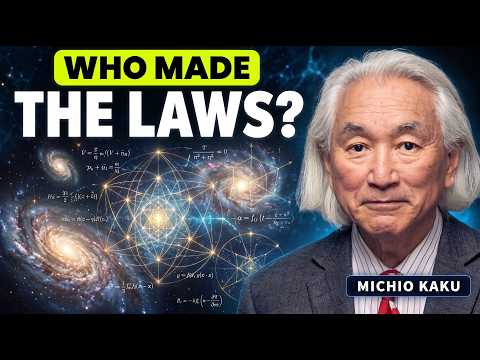
Where did everything come from? It is a question that reaches beyond astronomy into philosophy, religion and our understanding of reality. The video Could the Universe Create Itself? | Michio Kaku, published by Deep Reality Science, explores whether physics could describe a universe that begins without an external push. This article summarises its themes in our own words, while separating established observations from proposals that remain unproven.
The crucial distinction is what we mean by nothing. In everyday language, nothing means the complete absence of anything. In physics, a vacuum is a physical state described by fields and laws. Those are not the same thing.
A universe with zero total energy?
One intriguing idea is that positive energy in matter and radiation could be balanced by negative gravitational energy. If the total were zero, creating a universe might not require a net energy deposit from outside. This is sometimes described as a cosmic “free lunch”.
However, defining the total energy of the entire universe is not straightforward in general relativity. A zero-energy universe is an interesting possibility in particular models, not a measured fact or proof that the cosmos created itself.
The quantum vacuum is not empty
Quantum theory describes fluctuations even in a vacuum. The Casimir effect, a measurable force between closely spaced surfaces, illustrates how quantum fields and boundaries can produce physical effects. Empty space is more complicated than an empty box.
But this does not show that particles or universes appear from absolute nothingness. A quantum vacuum already belongs to a mathematical framework. Explaining what happens inside that framework is different from explaining why the framework exists.
Inflation: from a tiny beginning to a vast cosmos
Alan Guth's inflationary proposal suggests that the early universe underwent an extraordinarily rapid expansion. Such expansion could magnify tiny quantum fluctuations into the seeds of galaxies and large-scale structure.
The cosmic microwave background—the ancient radiation left from the hot early universe—provides powerful evidence for that early history. Its patterns are consistent with important inflationary predictions. They do not establish a unique inflation model, or demonstrate that the universe emerged from nothing. Inflation remains an active field of research.
Where did the laws of physics come from?
Alexander Vilenkin's quantum-tunnelling proposal and the Hartle–Hawking no-boundary proposal attempt to describe the universe's origin without an ordinary prior moment. Eternal inflation raises the possibility of many regions with different cosmic histories.
These are theoretical proposals, not directly observed accounts of creation. Each relies on physical or mathematical assumptions. Even if one eventually explains our universe's beginning, the question of why those laws exist may remain.
The honest bottom line
Physics offers remarkable ways to investigate cosmic origins, but it has not demonstrated that absolute nothingness produced everything. Nor can these models alone settle whether a creator exists. The distinction between evidence, interpretation and speculation matters.
Explore our Reality collection and Mark Thomson's CERN interview for more on the boundary between discovery and unanswered questions. Does explaining the universe's behaviour also explain why there is a universe at all?
Watch the source video
Video credit: Deep Reality Science, publisher of Could the Universe Create Itself? | Michio Kaku. Watch the original video on YouTube.
This is an independent channel, not Michio Kaku's official channel. The title is the publisher's; this summary does not claim that Kaku authored or endorsed the video.