Cornerstones · November 15, 2026 · Joseph Akinlabi
What Makes Someone British? The History of Britain, Ancestry and the Meaning of Belonging
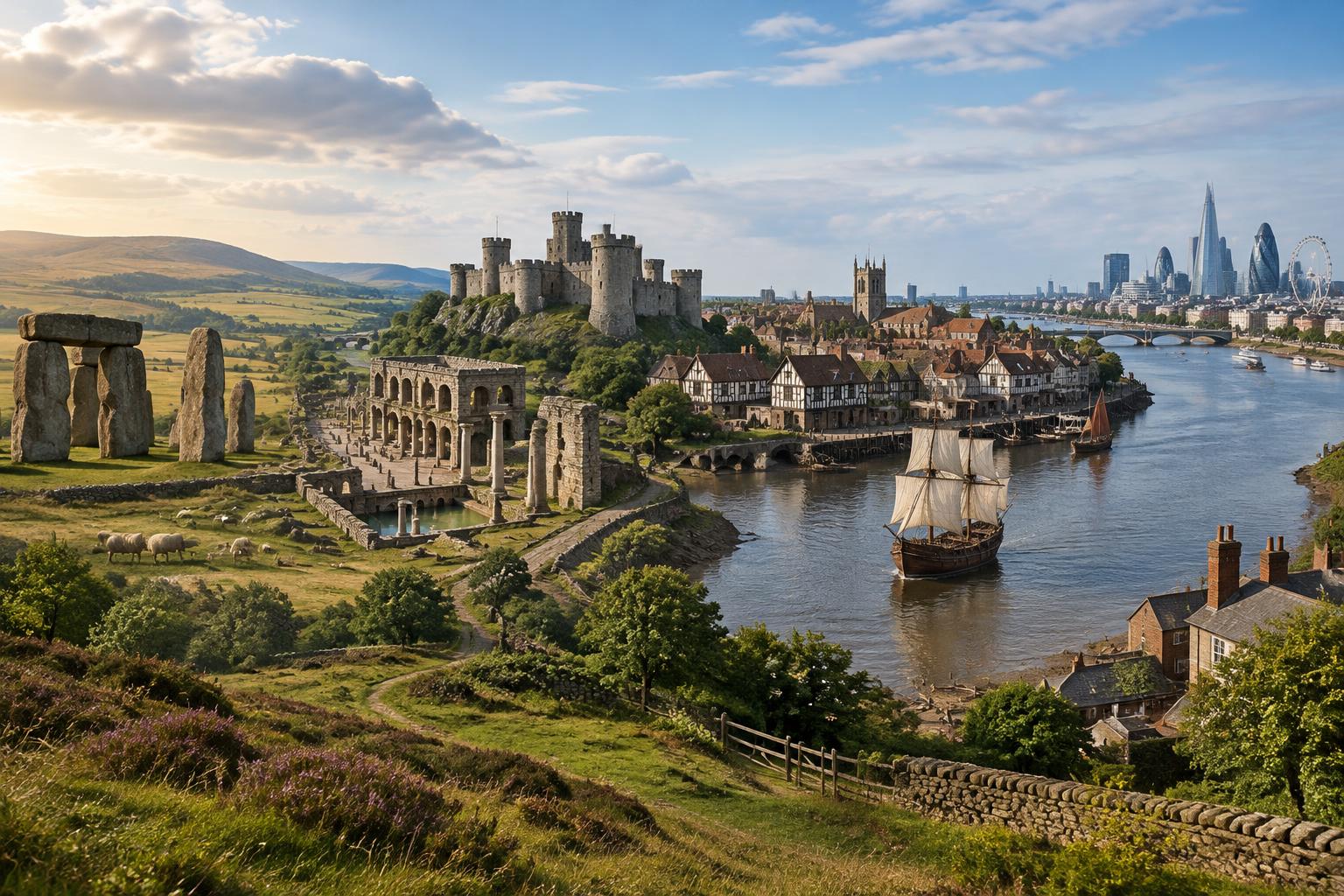
AI-generated historical montage: an imagined journey across eras, not a real landscape or archival photograph.
What does it actually mean to be British?
Is Britishness something inherited through your parents and ancestors? Is it determined by where you were born, the citizenship you hold, the culture you grow up in, the history you share, or the society in which you participate?
These questions are more complicated than they might initially appear.
The supplied brief describes a street interview in which one participant offered a particularly clear definition. He argued that Britishness is fundamentally about ancestry and inherited lineage. In his view, it is not something a person can acquire simply by living in Britain, adopting British customs, speaking English or becoming a British citizen.
Instead, he believes British identity is an inheritance passed down through generations, rooted in the ancestry of the people who formed the nation.
There is a legitimate argument to examine here. Ancestry, historical continuity and inherited culture are important aspects of how communities understand themselves.
But before we can assess this definition, we need to go back much further than the creation of England, the Anglo-Saxons or even the Roman occupation.
We need to understand the history of the island itself: the earliest human inhabitants, prehistoric communities, the arrival and influence of the Romans, the Anglo-Saxon migrations, the Vikings, the Normans, the development of England, the political union of Britain, the British Empire and the creation of modern Britain.
Because one of the central difficulties with defining Britishness is that the people, populations, cultures and political institutions associated with Britain have changed throughout history.
This does not mean that national identity has no meaning or that historical continuity is unimportant.
It means that if we want to understand who is British, we first need to understand how Britain itself came into existence.
Editorial context: the Freedom Watch GB video linked below supplies the street-interview perspective discussed in the originating brief. The argument is examined here as described in that brief; no transcript was supplied, so this article does not present the paraphrase as an independently checked verbatim quotation.
In this article
Watch · One perspective, not the whole discussion
The perspective that prompted this investigation
This video represents one perspective and covers only part of what this post examines. The article goes much further into the depth and complexity of the subject: prehistoric settlement, migration and conquest, political union, empire, citizenship law, ancestry and DNA, culture, ethnicity and personal belonging. No single interview or definition can capture all of those overlapping questions.
Credit to Freedom Watch GB for publishing the discussion, and to everyone who contributes respectfully—whether in the video, in the comments or elsewhere. Open debate and respectful discourse matter because they allow society to examine difficult questions without turning disagreement into hostility. Watch the original video on YouTube.
People should be able to hold and express an opinion. Doing that well means listening to others, being honest about uncertainty, distinguishing opinion from evidence, challenging ideas without demeaning people, and remaining willing to learn.
“The aim of an argument, or of discussion, should not be victory, but progress.”
1. Prehistoric Britain: Before England and British Identity (c. 900,000 BC–43 AD)
Palaeolithic: Human occupation changed with repeated glaciations. AI-generated illustrative reconstruction, not an archival photograph, archaeological record or evidence. (1 of 6)
Before England existed, before the Anglo-Saxons, before the Romans and long before anyone could describe themselves as British, people were already living on the land that would eventually become the British Isles.
The earliest known evidence of human presence in Britain dates back approximately 900,000 years, although estimates depend on the archaeological evidence being considered.
Stone tools discovered at Happisburgh in Norfolk and Pakefield in Suffolk provide evidence of some of the earliest human inhabitants. These communities lived in a landscape very different from the one we recognise today.
At various points in prehistory, Britain was connected to continental Europe by land. Changing sea levels, caused by glacial and interglacial periods, repeatedly altered the landscape and the relationship between Britain and mainland Europe.
This is important because the geographical separation of Britain by the English Channel is not an ancient, permanent feature of human history.
The people living here were not British or English in the modern national sense. They belonged to prehistoric populations whose identities, languages and social structures are largely unknown.
To understand this period, archaeologists divide prehistoric Britain into several broad stages.
The Palaeolithic: The Old Stone Age (c. 900,000–10,000 BC)
The Palaeolithic represents the longest period of human occupation in Britain.
People lived in small communities, relying primarily on hunting, gathering and the movement of animals across the landscape.
Several human species are associated with the wider prehistoric record, including Neanderthals and modern humans. Britain was not continuously inhabited throughout this entire period. Severe glaciations made parts of the land uninhabitable, and human populations came and went as environmental conditions changed.
The archaeological record provides evidence of tools, animal remains and traces of human activity.
What is particularly important here is that the earliest populations were not one continuous, unchanged group. Human occupation was shaped by climate, migration, environmental change and the survival or disappearance of different populations.
The Mesolithic: The Middle Stone Age (c. 10,000–4000 BC)
As the last Ice Age ended, the climate became warmer and the landscape changed.
Forests expanded, animal populations changed and communities adapted their lifestyles to new environments.
People continued to hunt and gather, but archaeological evidence reveals increasingly sophisticated tools, settlements and patterns of resource use.
Britain became separated from continental Europe by rising sea levels, with the formation of the English Channel and the North Sea as we know them today.
This geographical change had important consequences for future migration and contact with Europe, although movement across the sea remained possible.
The Neolithic: The New Stone Age (c. 4000–2500 BC)
The Neolithic brought a major transformation.
Farming spread into Britain, introducing domesticated animals, cultivated crops and more settled forms of community life.
People began constructing substantial monuments, burial sites and ceremonial landscapes.
Some of Britain's most recognisable prehistoric monuments developed during this broad period, including early phases of the Stonehenge landscape.
The arrival and spread of farming were connected to movements of people from continental Europe, alongside the adoption of new technologies and practices by communities already living in Britain.
This is an important reminder that population movement and cultural exchange were features of Britain's history long before the arrival of the Romans or Anglo-Saxons.
The Bronze Age (c. 2500–800 BC)
The Bronze Age saw the growing use of metalworking, particularly copper and bronze.
Trade networks expanded, objects and technologies travelled over considerable distances, and archaeological evidence shows changing burial practices and social organisation.
The period was also associated with significant population movements and changes in ancestry.
One particularly important development was the spread of Beaker-associated communities and material culture into Britain.
Research suggests that this period involved substantial demographic change, not simply the adoption of new fashions by an unchanged population.
However, archaeological cultures and genetic ancestry are not the same thing. A particular type of pottery or burial practice does not automatically identify a single ethnic group.
The Iron Age (c. 800 BC–43 AD)
By the Iron Age, Britain contained numerous communities with complex social and political structures.
People lived in settlements, farmed the land, traded with continental Europe and developed regional identities.
Many communities spoke languages belonging to the Celtic language family, although the exact linguistic and cultural landscape was diverse.
Groups such as the Iceni, Brigantes, Trinovantes, Catuvellauni and Silures are known from historical and archaeological evidence.
The term Celtic is often used to describe aspects of Iron Age Britain, but it is important not to imagine that the entire island was one unified Celtic nation.
There was no single government, national identity or central authority representing everyone living in Britain.
Instead, there were different communities, political groupings and tribal territories.
Some had established relationships with Rome before the invasion of AD 43, while others resisted Roman expansion.
Why this period matters to the question of Britishness
Before the Romans arrived, Britain already had a long and complicated history of human movement, settlement, cultural exchange and population change.
There was no single, unchanged ancestral population that can simply be identified as the original British people.
The earliest inhabitants were followed by other populations, and communities developed through a combination of continuity, migration and interaction.
This does not mean that ancestry is meaningless. It means that the ancestry of the people who eventually became associated with England and Britain has a much longer and more complicated history than one particular migration.
Roman settlement: Roman Britain was connected to a wider empire. AI-generated illustrative reconstruction, not an archival photograph, archaeological record or evidence. (1 of 1)
In AD 43, the Roman Emperor Claudius launched a full-scale invasion of Britain.
Roman forces began conquering parts of the island, encountering resistance from existing communities and political groups.
The conquest was not immediate or complete. Different regions were brought under Roman control at different times, and northern and western areas experienced prolonged military resistance.
By the end of the first century, Roman authority had become established across much of what is now England and Wales, although parts of northern Britain remained outside permanent Roman control.
Roman Britain became the province of Britannia, part of a much larger empire stretching across Europe, North Africa and the Middle East.
What changed under Roman rule?
Roman administration introduced or expanded:
Roads and military infrastructure.
Towns and urban settlements.
Roman law and systems of government.
Taxation and administrative institutions.
Trade networks connecting Britain to the wider empire.
New building techniques, architecture and engineering.
Roman religious practices, alongside existing beliefs and later Christianity.
Hadrian's Wall, constructed from AD 122, became one of the most recognisable symbols of Roman military organisation in Britain.
However, Roman rule did not mean that the existing population simply disappeared.
People living in Roman Britain included descendants of pre-Roman communities, people who adopted Roman customs, soldiers and administrators from other parts of the empire, traders and migrants.
Roman Britain was therefore already a society shaped by population movement and cultural interaction.
The end of Roman Britain
Roman authority weakened during the late fourth and early fifth centuries.
The Roman Empire faced serious pressures elsewhere, and military resources were increasingly required on continental frontiers.
Around AD 410, Roman imperial administration and military authority in Britain effectively ended.
This did not mean that every Roman person suddenly left Britain or that the population was replaced overnight.
Roman institutions weakened, urban life changed and different local authorities emerged.
Some Roman traditions and Christian institutions continued into the post-Roman period.
The end of Roman rule created the conditions for another major transformation in the history of Britain.
Why this period matters
The Roman period demonstrates that Britain was already connected to a wider European and Mediterranean world.
People from different parts of the Roman Empire travelled, served, traded and settled within the province.
The population of Roman Britain cannot be understood simply as an isolated native group.
3. Post-Roman Britain and the Anglo-Saxon Migrations (c. 410–793)
Early medieval community: Settlement, language and political consolidation developed over centuries. AI-generated illustrative reconstruction, not an archival photograph, archaeological record or evidence. (1 of 1)
The period following the end of Roman rule is one of the most important in the formation of England.
It is also one of the most difficult periods to reconstruct because the written evidence is limited and often comes from later sources.
With Roman government no longer providing central authority, Britain became politically fragmented.
Different local rulers and communities attempted to establish power.
There were continuing populations descended from people who had lived in Roman Britain, alongside communities in Scotland, Wales and Ireland with their own political and cultural histories.
During this period, groups commonly identified as Angles, Saxons and Jutes migrated from continental Europe.
Their origins are associated with areas of what are now northern Germany, Denmark and the Netherlands.
The precise nature of these movements remains debated.
Some accounts emphasise invasion and military conquest. Other research highlights settlement, migration, intermarriage and the gradual transformation of existing communities.
It is important not to assume that the entire population of Britain was replaced.
Archaeological and genetic research suggests substantial continental ancestry entered parts of Britain during the early medieval period, but the degree of change varied geographically.
The emergence of Anglo-Saxon kingdoms
Over time, different political kingdoms developed, including:
Northumbria.
Mercia.
Wessex.
East Anglia.
Kent.
Essex.
Sussex.
These kingdoms were not united under one English government from the beginning.
They competed for territory, influence and political authority.
Christianity also became increasingly important during this period. Missionary activity, the influence of the Church and the development of monasteries helped shape political and cultural life.
The Anglo-Saxon period saw the development of Old English, which became the foundation of the English language.
When did England become England?
This is a particularly important question.
The development of an English identity was gradual.
Different Anglo-Saxon kingdoms eventually became more closely connected through warfare, political alliances and the consolidation of royal authority.
The Viking invasions of the ninth century played a major role in accelerating this process.
By the tenth century, a unified Kingdom of England had emerged under rulers including Æthelstan, who became king of the English in 927.
This means that England did not simply exist as a fully formed nation when the Anglo-Saxons first arrived.
Its political identity developed over several centuries.
Why this period matters
The Anglo-Saxon period is central to the development of English language, institutions and identity.
However, the formation of England was a historical process involving existing populations, migration, political consolidation and cultural change.
It is therefore too simplistic to describe modern English identity as the unchanged inheritance of a single Anglo-Saxon population.
4. The Viking Age and the Formation of England (793–1066)
Scandinavian seafaring: Scandinavian migration and settlement influenced England. AI-generated illustrative reconstruction, not an archival photograph, archaeological record or evidence. (1 of 1)
In 793, a Viking raid on the monastery of Lindisfarne in Northumbria became one of the earliest clearly recorded Viking attacks on what is now England.
The Vikings came primarily from Scandinavia, including areas of modern Norway, Denmark and Sweden.
Initially, many raids targeted monasteries and coastal settlements, where valuable objects could be seized and people captured.
However, Viking involvement in Britain developed beyond raiding.
Viking armies began to establish settlements, control territory and influence political developments.
The Danelaw
In the ninth century, Viking forces established control over large parts of northern and eastern England.
These territories became associated with the Danelaw, an area in which Scandinavian law and political influence were significant.
The Viking presence had a lasting effect on language, place names, customs and population history.
Words such as sky, egg, law and take have Scandinavian linguistic origins.
The Vikings also intermarried and interacted with existing communities.
Alfred the Great and the emergence of a unified English kingdom
King Alfred of Wessex played an important role in resisting Viking expansion.
Following military conflict, Alfred negotiated an agreement with the Viking leader Guthrum, helping establish a division of territory.
Later rulers, including Edward the Elder, Æthelflæd and Æthelstan, expanded royal authority and brought further territories under English control.
By 927, Æthelstan had established authority over a much more unified English kingdom.
However, Scandinavian influence continued.
In the early eleventh century, Cnut ruled England as part of a wider North Sea political empire that included Denmark and Norway.
England's political and population history was therefore still closely connected to Scandinavia.
Why this period matters
The Viking Age is another example of migration, conquest, intermarriage and cultural exchange contributing to the development of England.
The people who became English were not simply descended from one isolated group.
The formation of English identity continued through contact between different communities.
5. The Norman Conquest and Medieval England (1066–1485)
Castle and town: New ruling structures coexisted with continuing local populations. AI-generated illustrative reconstruction, not an archival photograph, archaeological record or evidence. (1 of 1)
In 1066, England experienced another major political and demographic transformation.
Following the death of Edward the Confessor, rival claims to the English throne led to a succession crisis.
William, Duke of Normandy, invaded England and defeated King Harold Godwinson at the Battle of Hastings on 14 October 1066.
William became King of England, establishing Norman rule.
What changed after 1066?
The Norman Conquest transformed many aspects of English society.
Norman elites took control of land and political authority.
New castles were constructed to establish military control, and Norman French became an important language of government and the aristocracy.
The Church, legal administration and landholding systems also underwent significant changes.
The Domesday Book, completed in 1086, provides a remarkable record of landholding and economic resources in much of England.
However, the Norman Conquest did not replace the entire population.
The majority of people living in England continued to be descended from existing English communities, although the ruling elite changed substantially.
Over time, Norman and English populations interacted and intermarried.
The English language itself developed through the influence of Old English, Norman French and Latin.
Medieval England (1066–1485)
The medieval period witnessed:
The development of the English monarchy.
The expansion of Parliament.
The Magna Carta in 1215.
The growth of towns and trade.
The influence of the Church.
The Black Death in the fourteenth century.
The Peasants' Revolt of 1381.
The Hundred Years' War.
The Wars of the Roses.
These events shaped English political institutions, social structures and collective identity.
The medieval period also demonstrates that English identity continued to evolve long after the Anglo-Saxon kingdoms had been consolidated.
Why this period matters
The Norman Conquest is another reminder that the ancestry and culture of England were shaped by successive waves of settlement and political change.
The ruling elite changed, languages developed and social institutions were transformed.
Yet England remained recognisably a political and cultural community.
This raises an important question: if the Norman Conquest changed the population's ruling structures and cultural influences without making England cease to be England, what exactly constitutes continuity?
Tudor street: Religious and political change shaped English institutions. AI-generated illustrative reconstruction, not an archival photograph, archaeological record or evidence. (1 of 1)
The Tudor period began in 1485 following Henry VII's victory at the Battle of Bosworth, which ended the Wars of the Roses.
It was a period of significant political, religious and economic transformation.
Henry VIII's break with the authority of the Pope and the establishment of the Church of England changed the relationship between religion, monarchy and political power.
The dissolution of the monasteries transformed the ownership of religious land and wealth.
Under Elizabeth I, England experienced growing international influence, maritime expansion and conflict with Spain.
The defeat of the Spanish Armada in 1588 became an important moment in English national history.
The beginning of overseas expansion
The Tudor period also saw the development of English overseas ambitions.
English voyages, trade and attempts at colonisation laid foundations for later imperial expansion.
However, it is important to distinguish early overseas exploration and settlement from the much larger British Empire that developed in subsequent centuries.
At this stage, England was still a separate kingdom.
Scotland and Ireland had their own political identities and histories, even though English power and influence extended into Ireland.
Why this period matters
The Tudor period helped strengthen the institutions and political identity of England.
It also established important foundations for England's later role in global trade, colonisation and empire.
7. The Stuart Period and the English Civil Wars (1603–1714)
Civil war era: The Wars of the Three Kingdoms preceded later constitutional union. AI-generated illustrative reconstruction, not an archival photograph, archaeological record or evidence. (1 of 1)
In 1603, Elizabeth I died without an heir.
James VI of Scotland inherited the English throne and became James I of England.
This event is known as the Union of the Crowns.
It placed England and Scotland under the same monarch, but the two kingdoms remained politically separate.
This is an important distinction: sharing a monarch did not mean that Great Britain had already been created.
The English Civil Wars (1642–1651)
The Stuart period was marked by major conflicts over religion, political authority and the relationship between the monarchy and Parliament.
Disagreements between Charles I and Parliament eventually developed into civil war.
The conflicts involved England, Scotland and Ireland and are often understood as part of the wider Wars of the Three Kingdoms.
Charles I was executed in 1649.
The monarchy was abolished, and England became a republic under the Commonwealth, followed by the Protectorate under Oliver Cromwell.
The monarchy was restored in 1660 under Charles II.
The Glorious Revolution of 1688–1689 further changed the relationship between Parliament and the monarchy.
The creation of Great Britain in 1707
In 1707, the Acts of Union united the Kingdoms of England and Scotland into one political state called the Kingdom of Great Britain.
This is one of the most important dates in the history of British identity.
Before 1707, England and Scotland were separate kingdoms, even though they had shared a monarch since 1603.
After 1707, they became one kingdom with a single Parliament.
Ireland was not included in this union.
It became part of the United Kingdom of Great Britain and Ireland in 1801.
This means that the political identity of Great Britain is considerably more recent than the histories of the communities and kingdoms that came together to form it.
Why this period matters
The creation of Great Britain was a political development, not the emergence of a single ancient biological population.
The union brought together two previously separate kingdoms with different histories, institutions and national identities.
This is essential when examining claims that Britishness is simply an expansion of English or Anglo-Saxon ancestry.
8. The British Empire and the Wider World (16th–20th Centuries)
Colonial trade: Trade operated within systems of imperial power, extraction and resistance; this is not an East India Company archival image. AI-generated illustrative reconstruction, not an archival photograph, archaeological record or evidence. (1 of 1)
The creation of Great Britain in 1707 took place alongside the expansion of overseas trade, colonisation and imperial power.
The British Empire did not emerge at one precise moment. Its development took place over several centuries.
English overseas ventures began before the union of England and Scotland, while the British Empire expanded significantly after 1707.
The East India Company, established in 1600, became one of the most important organisations in the history of British imperial expansion.
Initially a trading company, it gradually acquired political and military power in parts of India.
Following the Battle of Plassey in 1757, the Company became increasingly influential in Bengal and later expanded its authority across much of the Indian subcontinent.
In 1858, following the Indian Rebellion of 1857, the British Crown assumed direct government of India from the East India Company.
Empire, trade and exploitation
British imperial expansion involved trade, military conquest, political control, settlement and the exploitation of resources.
The Empire became involved in the transatlantic slave trade and the plantation economies of the Caribbean and Americas.
The British Parliament abolished the slave trade in 1807, but slavery itself continued in British colonies until the Slavery Abolition Act 1833, with the main provisions taking effect in 1834 and an apprenticeship system continuing until 1838.
The history of empire also involved resistance, rebellion and independence movements across the world.
The relationship between Britain and India
India is particularly important to understanding modern British history.
British imperial rule in India involved economic extraction, political control, military power and profound social change.
It also created enduring connections between Britain and the Indian subcontinent.
People travelled between Britain and India for trade, military service, administration, education and family reasons.
These connections continued long after the end of colonial rule.
The creation of the United Kingdom
In 1801, the Acts of Union brought Great Britain and Ireland into a single political state called the United Kingdom of Great Britain and Ireland.
This was another major development in the political meaning of Britishness.
The modern United Kingdom was not created in the prehistoric period, during Roman rule or when the Anglo-Saxons arrived.
It emerged through a series of political unions and constitutional changes.
The decline of the British Empire
The twentieth century brought two world wars, economic pressures, anti-colonial movements and changing international relationships.
India and Pakistan became independent in 1947.
Many other colonies achieved independence over subsequent decades.
The British Empire gradually transformed into a different international relationship involving the Commonwealth and independent states.
There is no single date that marks the complete end of the Empire in every legal and political sense.
Why this period matters
The history of the British Empire demonstrates that Britain was not isolated from the wider world.
Its wealth, institutions, food, trade, population and international relationships were deeply connected to people and territories across the globe.
It also means that British history and the histories of countries such as India, Nigeria, Ireland and many Caribbean nations are intertwined.
This is particularly relevant when examining the idea that British and non-British histories can be separated into entirely independent stories.
9. Modern Britain: Immigration, Citizenship and National Identity (20th Century–Present)
Post-war arrivals: Illustrative post-war migration scene, not a photograph of the Empire Windrush or specific passengers. AI-generated illustrative reconstruction, not an archival photograph, archaeological record or evidence. (1 of 2)
The twentieth century transformed Britain in ways that continue to shape the debate about national identity today.
Two world wars changed Britain's position in the world.
The British Empire began to dissolve, and new relationships developed with independent countries across the Commonwealth.
The legal meaning of British nationality also changed.
The British Nationality Act 1948
The British Nationality Act 1948 established the status of Citizen of the United Kingdom and Colonies.
It reflected Britain's changing constitutional relationship with the Empire and Commonwealth.
The Act did not simply create a completely new right for anyone in the world to settle in Britain. It operated within the complicated legal framework of British subjecthood and Commonwealth membership.
The Windrush generation
From 1948 onwards, people from the Caribbean travelled to Britain to work and build their lives.
Many came in response to labour shortages and opportunities in post-war Britain.
They became part of the workforce in areas such as transport, healthcare, manufacturing and public services.
Their descendants are now an established part of British society.
The Windrush story is important because it demonstrates the relationship between nationality, legal status, immigration policy and the changing political treatment of people who had previously been recognised as British subjects.
Immigration controls and changing nationality law
The Commonwealth Immigrants Acts of 1962 and 1968 restricted the entry rights of many Commonwealth citizens.
The Immigration Act 1971 further reshaped immigration control and the right of abode.
The British Nationality Act 1981 established the modern categories of British nationality and changed the rules for acquiring British citizenship.
These developments demonstrate that the legal meaning of British nationality has not remained unchanged throughout history.
Modern British identity
Today, Britain contains people with many different ancestral backgrounds.
Some families can trace their ancestry in Britain back for many centuries. Others arrived more recently, while many have mixed family histories connecting Britain to countries across the world.
People may identify as British, English, Scottish, Welsh, Northern Irish, Irish, British Asian, Black British or through several overlapping identities.
The important point is that legal nationality, ethnicity, ancestry and personal identity are not necessarily the same thing.
Why this period matters
Modern Britain is the product of a long historical process involving migration, empire, political union, citizenship law and changing social relationships.
The question is not whether Britain has a history or whether its inherited traditions matter.
The question is how those traditions and that history relate to the people who belong to Britain today.
10. What Does the History Tell Us About British Ancestry?
Having examined the historical development of Britain, we can return to the original argument.
The speaker in the interview believes that Britishness is an inherited identity, rooted in a collective ancestry that has been passed down through generations.
He places particular emphasis on Anglo-Saxon ancestry, describing it as the foundation of the British people.
But the historical timeline raises several questions.
First, the people living in Britain before the Anglo-Saxons were already the product of thousands of years of human migration and population change.
Second, the Anglo-Saxon migrations did not occur in an empty country. They interacted with existing populations.
Third, the Vikings and Normans added further layers of settlement, political influence and ancestry.
Fourth, England itself emerged gradually through the consolidation of different kingdoms.
Finally, Britain as a political union was created in 1707 through the union of England and Scotland.
This creates an important distinction between ancestral continuity and political identity.
A person may have ancestry connected to a particular population that contributed to the formation of England.
But that does not automatically mean that the same ancestry provides a complete definition of Englishness or Britishness.
The question is not whether people inherit ancestry. They do.
It is whether ancestry alone can establish the boundaries of a modern nation.
11. What Does DNA Actually Tell Us About Being English?
Research, not identity tests: Ancient DNA studies compare reference populations; they do not set citizenship or belonging thresholds. AI-generated illustrative reconstruction, not an archival photograph, archaeological record or evidence. (1 of 1)
A major scientific study published in Nature in 2022 examined ancient DNA to investigate Anglo-Saxon migration and the formation of the early English gene pool.
The researchers identified substantial continental northern European-related ancestry among early medieval individuals in England.
They also identified ancestry associated with populations already living in Britain and ancestry related to Iron Age populations from France.
When examining present-day English populations, the researchers estimated ancestry proportions that varied considerably by region.
11–57% ancestry related to late Iron Age individuals from Britain.
14–43% ancestry related to Iron Age populations from France.
These figures are study-specific estimates based on ancient samples and statistical reference populations. They are not percentages of modern people who can be labelled Anglo-Saxon, Celtic or French.
The study is important because it demonstrates that the formation of the English population involved multiple ancestral contributions.
It does not establish that English identity is determined by possessing a particular percentage of DNA.
Nor does it establish a genetic threshold that someone must meet to be English.
Genetics can help investigate population movements, ancestry and biological relationships.
It cannot independently determine a person's nationality, cultural identity or political belonging.
The scientific question of where a population's ancestors came from is not the same as the philosophical question of who belongs to that nation today.
12. Culture: Is It Inherited or Can It Be Acquired?
Shared food traditions: Traditions can reflect both inheritance and cultural exchange. AI-generated illustrative reconstruction, not an archival photograph, archaeological record or evidence. (1 of 2)
Another important part of the interview concerns culture.
The speaker argues that British culture is inherited. He gives examples such as drinking tea, eating fish and chips and queuing.
He also connects queuing to the idea of a high-trust society, suggesting that shared behaviours reflect deeper social values and expectations.
There is something worth examining here.
Culture is not simply a list of customs. It includes language, traditions, social expectations, institutions, shared memories, humour, art, religion, food and ways of organising everyday life.
Much of this is passed down through families and communities.
But culture is also learned, adapted and exchanged.
Consider food. Fish and chips, now commonly associated with British cuisine, developed through a history of cultural exchange, including Jewish immigrant influences on fried fish and the wider development of the British food trade.
Tea itself has a history closely connected to international trade and Britain's imperial relationship with China and India.
These examples do not make these customs any less part of British culture.
They demonstrate that cultural inheritance and cultural exchange are not opposites.
Something can originate elsewhere, become established within a society and be passed down through generations until it becomes part of that society's own cultural inheritance.
This raises a difficult question for an ancestry-based definition:
If a cultural practice can become British through adoption and generations of shared participation, why must the people who contribute to that culture remain permanently outside British identity?
The speaker's response appears to be that cultural adoption does not automatically change someone's ancestry.
That is true in a narrow sense.
But it does not settle the wider question of national identity.
A nation is not simply a genetic population. It is also a historical, social and political community.
13. The Difference Between Ethnicity, Nationality and Citizenship
Perhaps the biggest source of confusion in the debate is that several different concepts are being used interchangeably.
It is useful to separate them.
Ancestry refers to a person's family descent and the populations from which their ancestors originated.
Ethnicity generally describes a shared group identity associated with elements such as common ancestry, historical memory, culture, language, traditions and community recognition.
Citizenship is a legal relationship between an individual and a state, involving rights, responsibilities and formal membership.
Nationality can refer to a legal status or to a person's identification with a nation. Its meaning depends on the context in which it is being used.
National identity concerns the nation or nations with which someone identifies or feels a sense of belonging.
These categories can overlap, but they do not have to.
A person can be ethnically Indian, hold British citizenship and identify as British.
Another person may have English ancestry, identify as English and British, and hold British citizenship.
Someone else may be born in England, grow up in an English community and identify as English, without having English ancestry.
The Office for National Statistics makes an important distinction in its Census 2021 methodology. It defines national identity as a self-determined assessment of identity: the country or countries where someone feels they belong or considers home.
It explicitly states that national identity is not dependent on ethnic group or citizenship.
That is a statistical definition designed to measure how people identify themselves. It is not a philosophical ruling that settles every disagreement about national belonging.
Nevertheless, it demonstrates that national identity and ancestry are recognised as separate concepts in official measurement.
Shared community: Citizenship, social participation and personal identity are related but distinct. AI-generated illustrative reconstruction, not an archival photograph, archaeological record or evidence. (1 of 1)
This is arguably the most interesting question in the interview.
The speaker repeatedly asks whether someone can become English or British.
His answer is effectively no: a person either inherits the relevant lineage or they do not.
But this depends on which definition we are using.
If we define Englishness exclusively as descent from a particular ancestral population, then someone cannot acquire that ancestry through education, citizenship or residence.
That conclusion follows from the definition itself.
However, if we are discussing legal nationality, the answer is different.
British citizenship can be acquired through different routes, including birth in qualifying circumstances, descent, registration and naturalisation.
The British Nationality Act 1981 sets out the legal framework. It does not require every person who becomes a British citizen through naturalisation to demonstrate Anglo-Saxon ancestry.
The distinction is therefore between an inherited ethnic identity and a legal national identity.
But there is also a wider cultural and social question.
Can someone become part of an English community through lifelong participation, shared institutions, language, relationships, experiences and identification?
That is not a question that DNA testing or a passport can answer on its own.
It is a question about what we believe a nation actually is.
The legal definition of British citizenship is clear enough to apply. The meaning of Englishness is more complex because England does not have a separate citizenship system that defines who is legally an English citizen.
15. The Mandla Case: Can Ethnicity Be Defined Through Ancestry Alone?
History and recognition: Illustrates shared history; it does not depict the parties in Mandla v Dowell Lee. AI-generated illustrative reconstruction, not an archival photograph, archaeological record or evidence. (1 of 1)
There is also an important legal case worth considering.
In Mandla v Dowell Lee (1982), the House of Lords considered whether Sikhs constituted an ethnic group for the purposes of the Race Relations Act 1976.
The judgment examined the relationship between common history, cultural tradition, geographical origin, ancestry, language, group identity and shared customs.
Lord Fraser identified two essential characteristics of an ethnic group:
A long shared history, of which the group is conscious and which it keeps alive.
A cultural tradition of its own, including family and social customs and manners.
He also identified other relevant characteristics, including geographical origin, common ancestry, language, literature, religion and the experience of being a minority, oppressed group or dominant group.
Crucially, the judgment did not require ethnic identity to be established through biological proof.
Lord Fraser explained that membership could arise through birth or adherence. Someone who joins a group may qualify if they identify with it and are accepted by its members.
This case was about the legal meaning of an ethnic group under discrimination legislation. It was not a judgment defining British nationality or deciding who is English.
Nevertheless, it illustrates something important: even when the law recognises ethnic identity, it does not necessarily reduce it to biological descent.
Ethnicity can involve a combination of inherited history, cultural continuity, collective recognition and participation.
Inherited and shared histories: Continuity can involve ancestry, traditions, institutions and participation. AI-generated illustrative reconstruction, not an archival photograph, archaeological record or evidence. (1 of 1)
There is a legitimate concern underneath the ancestry argument that should not be overlooked.
People may feel that their national history, traditions, institutions and shared identity are important and deserve protection.
They may worry about rapid cultural change, weakening social cohesion or the loss of traditions that have been passed down through generations.
These concerns should not automatically be dismissed.
A country can have a distinctive history and culture. It can also debate immigration levels, integration, citizenship requirements and the responsibilities of people who settle there.
But there is a distinction between preserving a nation's cultural continuity and defining its membership exclusively through inherited ancestry.
If national identity is understood only as a fixed biological inheritance, then the question becomes whether people with different ancestry can ever genuinely belong, regardless of how deeply connected their lives are to the country.
If national identity is understood only as a collection of values that anyone can adopt, another question arises: what happens to the historical continuity, traditions and collective memory that distinguish one nation from another?
Neither question should be ignored.
Perhaps the more useful approach is to recognise that nations contain several overlapping dimensions: ancestry, historical memory, culture, political institutions, citizenship and personal identification.
These dimensions may reinforce one another, but they are not identical.
17. Conclusion: IS BRITISHNESS SOMETHING YOU INHERIT, OR SOMETHING YOU CAN BELONG TO?
The interview raises a question that goes beyond immigration.
It asks what a nation actually represents.
Is Britain primarily an ancestral community whose identity is passed down through generations?
Is it a political community created through law, institutions and citizenship?
Is it a cultural community shaped by shared customs, history, language and social experience?
Or is it a combination of all these things?
Ancestry is a genuine part of national history. It helps explain population origins, family continuity and the transmission of traditions.
But it does not, by itself, establish a complete definition of modern national identity.
The history of Britain shows that the populations, institutions and identities associated with these islands developed through prehistoric migration, Roman rule, Anglo-Saxon settlement, Viking influence, Norman conquest, political union, empire and more recent migration.
The history of England shows that English identity developed through successive periods of political consolidation and cultural change.
The history of Great Britain shows that the wider British political identity developed through the union of different kingdoms and nations.
And the modern legal system recognises that British citizenship can be acquired through more than inherited descent.
None of this means that history, ancestry or cultural continuity are unimportant.
It means that we need to be precise about what we are talking about.
There is a difference between asking where someone's ancestors came from and asking which nation they belong to.
There is a difference between being ethnically English and identifying as English.
And there is a difference between having British citizenship and feeling British.
Perhaps the most important question is not whether ancestry matters. It clearly does.
It is whether ancestry should be the only thing that determines who can belong to a nation.
If someone is born in England, grows up within its communities, speaks its language, participates in its institutions, shares its history and considers it home, what exactly is missing that means they can never be English?
And, equally, if someone has ancestral connections to England but has never lived there, does that ancestry alone tell us everything we need to know about their relationship with the country?
These are questions worth exploring rather than answering with assumptions.
Because before we can decide who belongs to a nation, we need to understand what we mean by the nation itself.
18. Further reading and trusted sources
The following sources provide further historical, scientific, legal and statistical context for the subject. They cover the development of prehistoric Britain, population movements, the formation of England, the British political union, empire, nationality law and national identity.
Image transparency: all pictures in this article are AI-generated illustrations or reconstructions. They are not documentary evidence, portraits of identified individuals, exact historical maps or photographs of original archaeological objects. The linked historical, scientific and legal sources—not the illustrations—support checking the article’s claims.