
What would you do if you believed you had discovered a way to approach one of humanity's most difficult medical challenges?
What if that belief came from personal experience?
What if you had spent years developing your knowledge, pursuing your research and trying to turn an idea into something that might eventually help people?
And what if the next step required resources you could not easily obtain?
Would you change your approach to attract investment?
Would you accept a different business model?
Would you compromise some of your original ambitions to give the project a better chance of progressing?
Or would you try to find another way?
These are some of the questions raised by the story of Dr Hadiyah-Nicole Green, an American physicist and cancer researcher who established the Ora Lee Smith Cancer Research Foundation.
Her work brings together several things that I find fascinating about people.
Scientific curiosity.
Personal loss.
Determination.
A desire to help others.
And a commitment to pursuing a mission in a way that she believes will preserve its purpose.
But her story also raises difficult questions about research funding, affordability, commercial incentives and the opportunities available to scientists trying to turn promising ideas into practical treatments.
This is not a story about pretending that every ambitious idea will succeed.
It is not a story about assuming that pharmaceutical companies are bad or that commercial investment is always wrong.
And it is not a claim that an experimental cancer treatment has already been proven to work in people.
It is a story about a scientist's mission, the challenges she has described, and the wider questions those challenges raise about human potential.
Because sometimes, when we examine one person's journey closely, we discover something much bigger about the world around us.
And perhaps something about ourselves.
Latest developments: October 2026 update
If you first encountered Dr Green's story around six years ago, it is worth separating that moment of discovery from the date of the research. The underlying mouse study is older: it was published in 2014, not six years ago. Public attention, a laboratory result and a proven human treatment are different milestones.
September 17, 2026: a new interview
In Elsevier Osmosis's Raise the Line interview, Dr Green discusses her research, nonprofit model and the money needed for human clinical trials. The interview describes work towards those trials, not completed evidence of clinical effectiveness.
February 2026: an announced regulatory milestone
Dr Green announced on World Cancer Day, February 4 that Laser-Activated NanoTherapy (LANT) received FDA Breakthrough Device Designation; she also discusses this in the September interview. This account comes from her announcement and interview, rather than an FDA public notice naming LANT that we independently located.
The FDA explains that its Breakthrough Devices Program helps expedite development and review. Designation is not FDA marketing approval, proof of effectiveness in humans, or permission to skip safety requirements.
Fundraising and preparations continue
The foundation's current website and clinical-trials information still describe raising funds to begin human trials. In the sources checked for this update, we found no reliable confirmation that human trials have begun.
Its homepage describes US$10 million as an initial step in a much larger undertaking, while its speaking-request page gives a US$30 million target for clinical trials and FDA approval. These are different published descriptions; without clarification from the foundation, they should not be presented as one settled current target.
2026–2027: awareness and fundraising outreach
ROCTOWNLIVE describes a partnership with the foundation involving digital storytelling and AI-assisted videos to increase awareness and support. That is an outreach development, not new clinical evidence.
The current picture: a continuing research mission, an announced designation and ongoing fundraising—not an established cure available to patients. This update was checked on October 12, 2026.
1. The Personal Experience Behind the Mission
When loss becomes motivation
Behind many important human endeavours, there is a story that begins long before anybody else notices the work.
Sometimes it begins with curiosity.
Sometimes it begins with a problem.
And sometimes it begins with something deeply personal.
For Dr Hadiyah-Nicole Green, her motivation to pursue cancer research was connected to the loss of her aunt, Ora Lee Smith, who died of cancer.
She also experienced the impact of caring for an uncle with cancer. These experiences helped shape the direction of her work.
In 2016, she established the Ora Lee Smith Cancer Research Foundation, named in honour of her aunt.
According to the foundation's account, Ora Lee Smith helped raise Dr Green from childhood. Her aunt's experience of cancer and concerns about the effects of treatment became an important part of the story behind the research mission.
There is something powerful about the way personal experience can change the questions we ask.
A problem that once seemed distant can suddenly become immediate.
It is no longer simply a subject we read about.
It becomes something we have witnessed.
Something that has affected people we love.
Something we want to understand, challenge or perhaps find a way to improve.
Of course, grief does not automatically produce a mission. People respond to loss in many different ways, and there is no single correct response.
But sometimes, an experience becomes the starting point for a determination to do something.
A question begins to form.
Could this be approached differently?
Could more be understood?
Could somebody else be helped?
And that question can develop into years of learning, research and effort.
This is one of the reasons I wanted to explore Dr Green's story.
Before we consider the science, the funding or the business model, we need to understand that the work was connected to something meaningful in her own life.
The research was not simply an abstract commercial opportunity. It was connected to an experience that helped shape what she wanted to pursue.
And that brings us to a question worth considering.
How often do the things that matter most to us begin with something we have personally experienced?
Sometimes our interests are born from joy.
Sometimes from curiosity.
Sometimes from frustration.
And sometimes from a desire to prevent other people from experiencing something we have seen or endured ourselves.
We may not know where those experiences will lead.
But they can become the beginning of a spark.
Read more: Dr Hadiyah-Nicole Green — Official Biography and About the Ora Lee Smith Cancer Research Foundation.
2. The Science and the Possibility
What was Dr Green trying to achieve?
Dr Green's research has involved laser-activated nanotherapy, an experimental approach that combines nanotechnology and light to target tumours.
In the research associated with her work, nanoparticles are introduced into a tumour and then exposed to near-infrared laser light. The particles absorb the light and generate heat, which is intended to damage tumour tissue.
This is known as a form of photothermal therapy.
The idea is intriguing because it explores whether treatment could be directed towards a particular area while limiting damage to surrounding healthy tissue.
However, the details matter.
A scientific idea can be promising without yet being a proven medical treatment. Results depend on the particular method, tumour model, delivery system, treatment conditions and the evidence collected.
A 2014 peer-reviewed paper co-authored by Dr Green examined intratumoral near-infrared photothermal nanotherapy in mice. The researchers reported substantial tumour regression in the treated experimental models.
That is a genuine preclinical research result.
But it is not the same as demonstrating that the approach is safe and effective in human patients.
Animal studies are an important part of biomedical research, yet treatments that produce promising results in animals do not always translate successfully into human medicine.
Human clinical trials are needed to evaluate safety, appropriate dosing, possible side effects and evidence of effectiveness in people. Those trials must be conducted under appropriate ethical and regulatory oversight.
This is not a reason to dismiss experimental research.
It is a reason to understand what each stage of research can tell us.
Some approaches eventually become valuable treatments.
Others need to be modified.
Some do not work as hoped.
The important thing is to remain open to possibility without abandoning our responsibility to evidence.
We should be able to recognise the ambition behind Dr Green's research without overstating its results.
We can ask whether an idea deserves further investigation without assuming that it will ultimately succeed.
And we can respect a scientist's determination while recognising that scientific outcomes cannot be guaranteed by determination alone.
The purpose of research is not to confirm what we want to believe. It is to discover what the evidence can support.
That is what makes the journey from an idea to a potential treatment so demanding.
Primary scientific source: A histological evaluation and in vivo assessment of intratumoral near-infrared photothermal nanotherapy-induced tumour regression — PubMed.

3. The Ora Lee Smith Cancer Research Foundation
More than an idea
An idea can begin with one person.
But turning that idea into something that might help others requires more than the original insight.
It requires organisation.
Resources.
Expertise.
Planning.
And a structure through which the work can continue.
That is where the Ora Lee Smith Cancer Research Foundation enters the story.
Dr Green established the foundation in 2016, connecting her research ambitions with the name and memory of her aunt.
The foundation's stated mission is to support research towards cancer care that is accessible, affordable and effective. It describes its nonprofit structure as a way to help fund the development of the technology and move towards human clinical trials.
That is the organisation's stated purpose. The scientific and clinical outcomes still need to be assessed through the relevant research and regulatory processes.
There is an important distinction here.
A mission explains what an organisation wants to achieve. Evidence establishes what it has achieved.
Both matter, but they are not interchangeable.
A foundation can have a compelling mission and still face considerable scientific, financial and organisational challenges. Likewise, the existence of those challenges does not automatically mean the mission lacks value.
There is often a considerable distance between having an idea and being able to put it into practice.
A scientist may have the knowledge to investigate a problem but still need access to laboratories, equipment, clinical collaborators, funding and the wider infrastructure required to progress.
A person may understand what they want to achieve but not have all the resources necessary to achieve it.
This is true beyond science.
An aspiring musician may need equipment and time to practise.
A community organiser may need a place to meet and people willing to contribute.
An entrepreneur may need capital, customers and specialist advice.
A researcher may need funding to test whether an idea can work.
Human potential matters.
But potential does not operate in isolation from the conditions surrounding it.
And that is why I think Dr Green's story is worth examining beyond the scientific question alone.
It asks us to consider what happens after somebody discovers something they care deeply about.
How do they build the structures needed to pursue it?
Who can help?
What resources are required?
And what happens when those resources are difficult to obtain?
Read more: Ora Lee Smith Cancer Research Foundation — About.
4. The Fight for Affordable Cancer Research
Who will be able to benefit?
One of the clearest themes in Dr Green's public account is affordability.
She wants the research to have the potential to benefit people who might otherwise struggle to access expensive cancer treatment.
That concern is central to how the foundation describes its mission.
And it raises an important question.
What does it mean to develop something valuable if the people who need it cannot afford to access it?
Scientific innovation and access to innovation are related, but they are not the same thing.
A discovery may offer a possibility.
But turning it into a treatment requires further development, testing, manufacturing and delivery.
Even if a treatment eventually proves safe and effective, questions remain about its cost and accessibility.
Who will provide it?
What equipment will be needed?
What will it cost to manufacture and deliver?
Will healthcare systems be able to provide it?
Will patients be able to access it?
These questions matter because progress is not experienced equally by everybody.
Financial circumstances, geography, healthcare infrastructure and the resources available to individuals can all influence access to treatment.
Of course, affordability cannot replace safety or effectiveness. A treatment must meet the necessary standards, and the costs of developing and delivering it are real.
But access deserves serious consideration.
For Dr Green, affordability is not simply a secondary consideration to be addressed after the research has progressed. It is part of the mission she wants to protect.
That is what makes this more than a story about developing a new scientific approach.
It is also a story about what innovation is ultimately for.
Is it enough to ask whether we can develop something?
Should we also ask how it might be made available to those who need it?
And how do we balance the considerable costs and risks of developing new treatments with the desire to make successful treatments accessible?
There are no simple answers to all these questions.
But they are questions worth asking.
Because the purpose of innovation should not be separated entirely from the human needs it is intended to address.
Scientific progress matters. So does the question of who gets to benefit from it.
5. Independence, Investment and the Pharmaceutical Industry
Who decides the direction of the work?
Another defining part of Dr Green's story is her preference for advancing the research through a nonprofit foundation rather than relying entirely on a conventional commercial route.
Her stated concern is that the structure used to fund and develop the technology can influence its eventual direction, particularly when it comes to affordability, ownership and access.
It is important to understand what this does and does not mean.
It does not mean that every pharmaceutical company is bad.
Commercial investment plays a significant role in the development, testing, manufacturing and distribution of medicines.
Companies can provide expertise, infrastructure and financial resources that are essential to turning research into treatments.
But commercial organisations also operate within financial incentives.
They have to consider costs, investment risks, returns and the commercial viability of the products they develop.
Those incentives can sometimes align with public health needs.
At other times, they can create difficult tensions around pricing, access and priorities.
The important question is not whether commercial activity should exist.
Questions like these are easy to turn into sides. It is worth learning how to disagree without creating division, so the debate stays focused on evidence rather than camps.
It is how different funding and ownership structures influence the decisions that are made.
Dr Green believes a nonprofit approach offers a way to protect the mission she wants to pursue. That is a strategic choice based on her priorities; it does not, by itself, prove that every commercial alternative would undermine affordability or that a nonprofit model automatically guarantees it.
The wider principle is worth examining.
The way we organise a project can influence what that project is ultimately able to do.
A business model is not simply a way of bringing money into an organisation.
It can affect who makes decisions, what success looks like and which objectives take priority when difficult choices arise.
And that matters when the original motivation is connected to a public-interest goal.
The challenge is finding a structure that can secure the resources needed to do the work while remaining accountable to its purpose.
That is not always straightforward.
A nonprofit still needs money, effective management, expertise and oversight.
A commercial business can still place public benefit at the centre of its mission.
The label alone does not guarantee the outcome.
What matters is how the organisation operates and whether its decisions remain consistent with its stated objectives.
Dr Green's story invites us to ask a difficult but useful question:
If you are trying to solve a problem, how do you secure the resources you need without losing control of what you are trying to achieve?
6. The Refusal to Sell Out
What are you unwilling to compromise?
The phrase selling out often appears when people discuss ambition and integrity.
But it can be misleading if we use it without thinking carefully.
Accepting investment is not automatically selling out.
Making money from your work is not automatically selling out.
Changing your plans when new evidence emerges is not automatically selling out.
Sometimes, adapting is precisely what allows a project to survive.
Sometimes, bringing in a commercial partner provides the resources and expertise needed to achieve something worthwhile.
The real question is what is being compromised, and why.
Are you changing the approach because you have discovered a better way to achieve your original objective?
Or are you gradually abandoning that objective because somebody is offering you a reward for pursuing something different?
Those are different situations.
In describing her approach, Dr Green has emphasised protecting the affordability and independence she wants the foundation's mission to retain. We can examine that decision without assuming that her chosen model is the only viable one.
It raises a question that applies to many of us.
When we begin something, we usually have an idea of why it matters.
Perhaps we want to build a business that gives us greater independence.
Perhaps we want to create something useful.
Perhaps we want to help people.
Perhaps we want to explore an idea that has captured our imagination.
But as a project grows, other incentives begin to appear.
Money.
Recognition.
Status.
Pressure from customers, investors or colleagues.
The desire to expand.
The desire to prove ourselves.
Some of those incentives can be useful. Others can pull us away from the reason we started.
The challenge is not to reject every compromise.
It is to know which compromises are reasonable and which ones would fundamentally change what we are trying to achieve.
This is where the story connects with the philosophy behind Get Out Rat Race.
The rat race is not simply about having a job or earning a salary.
It can also be about becoming so focused on external measures of success that we lose sight of our own values.
We can become very successful at pursuing something we never really wanted.
We can build something impressive that no longer reflects the person we hoped to become.
And we can spend years chasing rewards without asking whether the direction we are travelling still makes sense to us.
Integrity is not about refusing to change. It is about understanding what must remain true when everything else changes.

7. Funding the Next Stage of Research
When a promising idea needs resources
One of the most striking details in the interview that inspired this article was the funding target.
At the time of that conversation, Dr Green said the foundation needed US$10 million to begin human clinical trials.
She described having clinical partners prepared to host trials but needing the funding required to move forward.
That figure belongs to the historical interview, not necessarily to the foundation's current funding position.
The foundation's website publishes fundraising information and financial reports, and different pages have described different funding goals. Anyone quoting a current target should check the latest annual report and fundraising information rather than repeating an older interview figure as though it were current.
The broader point remains: moving an experimental treatment into human trials can require substantial resources.
There are scientific, clinical, regulatory and operational requirements that must be met.
Research teams need appropriate facilities, equipment and expertise.
Trials require careful design, oversight and monitoring.
And funding decisions have to take account of uncertainty and risk.
The fact that a project needs substantial funding does not, by itself, establish that it has been treated unfairly or that the research will ultimately succeed.
Funders have to make difficult choices between competing projects.
They need to consider evidence, feasibility, potential benefits and the probability that a project can progress.
But Dr Green's account still raises an important question.
What happens when a person believes they have a worthwhile idea, has invested years of work in it, and reaches a point where the next stage depends on resources they cannot easily secure?
The idea does not necessarily disappear.
The person does not necessarily lose their motivation.
But the work can stall.
And this is one of the wider issues that interests me about human potential.
We often celebrate the individual who has an idea.
We admire the determination.
We share the story.
We tell people to pursue their dreams.
But the practical conditions needed to pursue those dreams can receive far less attention.
Time.
Money.
Equipment.
Education.
Networks.
Collaborators.
Access to institutions.
And people who are willing to help.
Not every idea will succeed, and not every project should receive funding.
But we should recognise that ability and opportunity are not the same thing.
A person can be capable of doing something valuable and still lack the resources needed to pursue it.
Sometimes the difference between an idea remaining an idea and progressing to the next stage is not simply the person's determination.
It is whether the surrounding conditions make that next step possible.
Read the foundation's published financial information: Annual Reports and Financial Statements.
8. Praise Is Not the Same as Support
What does it mean to support a mission?
In the interview, Dr Green described people praising the work and expressing support, but not necessarily providing the financial contributions that the foundation needed.
Her appeal was to turn goodwill into practical support.
This raises a question that applies far beyond cancer research.
How often do we say something matters to us without taking any action to support it?
We admire the musician but never support their work.
We praise the community project but never offer our time.
We celebrate an independent creator but expect everything they produce to be free.
We encourage somebody to pursue a difficult mission but do not consider what might actually help them continue.
Of course, there are many reasons people cannot contribute financially.
Some people are struggling with their own circumstances.
Others already support causes that matter to them.
And nobody should feel pressured to donate money they cannot afford.
Support can take many forms.
It can mean sharing reliable information.
Offering relevant skills.
Volunteering.
Making introductions.
Helping a project reach the right audience.
Or simply being honest about what we can realistically contribute.
The distinction is not between people who donate and people who do not.
It is between treating support as a vague expression of approval and considering whether there is a practical way to help something we genuinely value.
For anyone supporting a cause, that might mean checking what the organisation is doing, understanding its goals and deciding whether its work aligns with their priorities.
For anyone running a project, it might mean being clear about what is needed, how contributions will be used and what supporters can reasonably expect.
Trust matters.
Transparency matters.
And people should be able to make informed decisions about the causes they support.
The wider lesson is simple.
An ambition may begin with one person, but making it possible can require the contribution of many.
Sometimes the most useful question we can ask is not simply whether we admire somebody's mission.
It is whether there is anything practical we can do to help.
9. Black Scientists, Recognition and Opportunity
Who gets the chance to contribute?
Dr Green has spoken about her experiences as a Black woman working in physics and cancer research. She has described difficulties around recognition, support and being taken seriously.
Her account raises broader questions about how opportunities are distributed in science.
Who gets access to research networks?
Who attracts funding?
Whose work receives attention?
And who gets the chance to develop an idea into a serious research programme?
These are important questions because scientific ability and access to opportunity are not identical.
A person may have the knowledge and determination to pursue a problem but lack the connections, resources or institutional support that help research progress.
There is also independent evidence that funding disparities have existed in US biomedical research.
A 2019 study published in Science Advances, examining National Institutes of Health research-project grant applications from 2011 to 2015, found that applications from Black scientists were funded at lower rates than applications from white scientists. The researchers identified several contributing factors, including differences in review outcomes and research-topic choices.
The study does not establish why Dr Green encountered any particular difficulty, and it should not be used as proof of a specific allegation about her individual project. It does, however, provide wider evidence that disparities in research funding are a legitimate subject of investigation.
That distinction matters.
Taking somebody's experience seriously does not require us to treat every broader claim as already proven.
And asking for evidence does not require us to dismiss the experience that prompted the question.
Both can be true.
We can listen carefully to what somebody says happened to them while also investigating the wider patterns that might help explain their experience.
The principle is important because science depends on rigorous scrutiny, but it also depends on people having a genuine opportunity to contribute.
The aim should be to evaluate research on its merits, maintain high standards and make sure that talent is not overlooked because it comes from outside familiar networks.
We cannot know how many promising ideas never reach their potential.
But we should ask whether institutions are doing enough to identify valuable work wherever it emerges.
Because the benefit is not only to the individual researcher.
It is also to society.
When people have a fair opportunity to develop their abilities and test their ideas, we increase the possibility of discovering something useful.
If we care about human flourishing, we should care about both the quality of people's contributions and their opportunity to make them.
Further reading: NIH — Research topic contributes to persistent gap in NIH research grants to Black scientists.
10. A Calling, a Purpose or a Divine Assignment?
A labour of love
In the interview, Dr Green described her work as her divine assignment.
She spoke about it as a labour of love, connected to personal loss and her determination to pursue a different possibility for people facing cancer.
The phrase may mean different things to different people.
For some, a divine assignment is a spiritual conviction.
For others, the equivalent might be a calling, a sense of responsibility or a problem they feel compelled to explore.
We do not all have to share the same beliefs to understand the experience she was describing.
Sometimes a person discovers something that matters so deeply to them that the work becomes more than a route to money or recognition.
It becomes connected to their sense of who they are and what they want their life to stand for.
That can be a powerful source of motivation.
But purpose does not make somebody infallible.
A person with a meaningful mission still needs evidence, support, resources and accountability.
Their work may encounter setbacks.
Their assumptions may need to change.
And the outcome they hope for may never arrive.
A strong sense of purpose does not remove uncertainty.
It can, however, give somebody a reason to keep working through it.
And that is what I find compelling about this part of Dr Green's story.
Not the idea that we should place her on a pedestal.
Not the assumption that determination guarantees success.
But the possibility that a person can take an experience that affected them deeply and use it as the motivation to pursue something they believe could help others.
We see this in different forms across human life.
Some people want to understand the universe.
Others want to create music, build things, grow food, teach children, solve problems or contribute to their communities.
Their motivations may be different.
But they can all be expressions of something meaningful to the person pursuing them.
And perhaps this is one of the questions we should ask ourselves more often.
What is important enough to us that we are willing to learn, practise, persevere and contribute?
What are we curious about?
What problems do we care about?
And what would we like our time and abilities to make possible?
11. The Wider Human Spark
Not every spark needs to change the world
Dr Green's story is a powerful example of a spark developing into a mission.
But I want to broaden the conversation.
There is a danger in focusing only on people whose work has enormous ambitions or the potential to reach millions.
We can begin to think that a passion matters only when it produces something extraordinary.
A scientific breakthrough.
A successful company.
A famous career.
A contribution recognised by the world.
But human flourishing is broader than achievement.
Over the years, I have heard stories about people and the things that bring them alive.
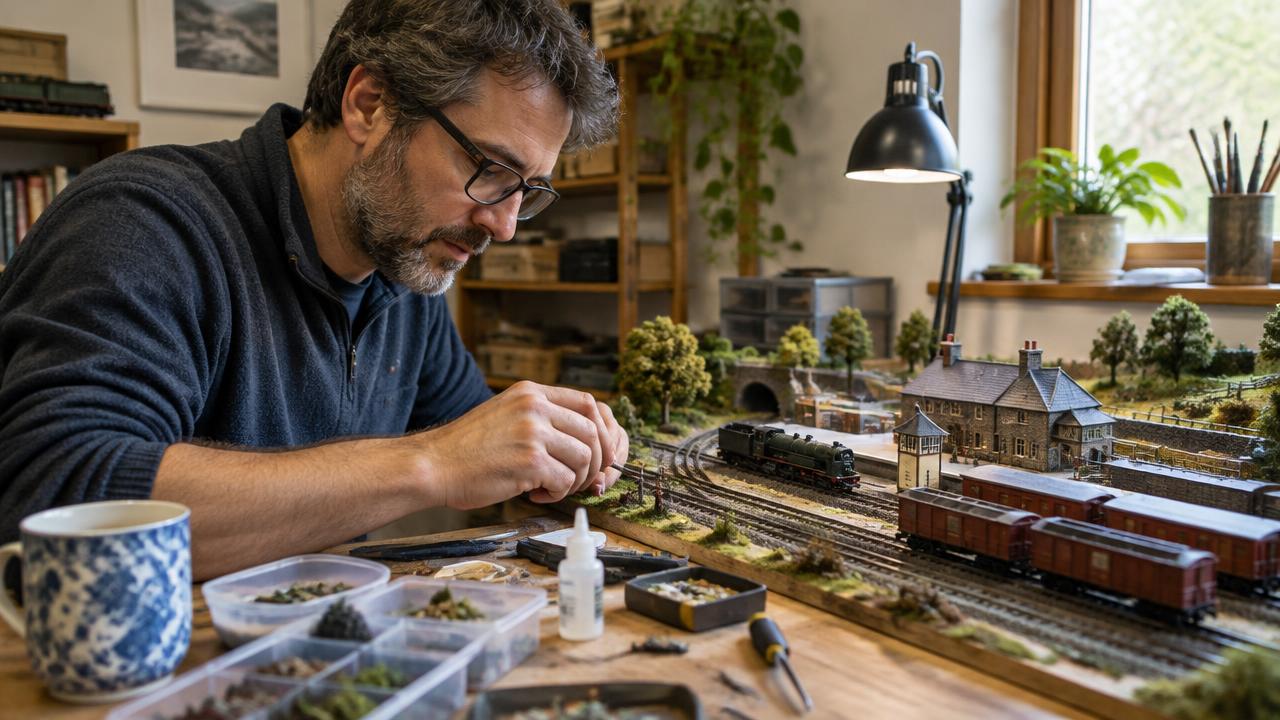
People fascinated by model railways.
People who can spend hours studying the stars.
Gardeners who find satisfaction in growing something from a seed.
Musicians who practise for years because they love the process.
People absorbed in chess, LEGO, woodworking, collecting, engineering or countless other interests.
Some of these people develop exceptional skills.
Some turn their interests into careers or businesses.
Some share their knowledge with others.
And some simply enjoy what they do.
There is value in that, too.
Not every interest has to become a business.
Not every hobby has to become productive.
Not every passion needs an audience.
And not every meaningful activity needs to be justified by the amount of money it generates.
Sometimes the value is in learning.
Sometimes it is in creating.
Sometimes it is in the satisfaction of solving a difficult problem.
Sometimes it is in the relationships we build with people who share our interests.
And sometimes, it is simply in the joy of doing something we love.
This is an important distinction for Get Out Rat Race.
The message is not that everybody should turn their passion into a business.
It is that we should pay attention to what genuinely matters to us and consider how we want to express it in our lives.
For one person, that might mean building a business around something they know.
For another, it might mean changing careers.
For someone else, it might mean volunteering, creating something, learning a skill or making more time for a hobby.
And for another person, it might mean continuing to pursue an interest that never earns a penny.
Those are different paths.
Their value cannot be measured by one financial calculation.
Dr Green's story shows how a personal spark can become a mission with ambitions that reach beyond the individual.
The model railway enthusiast reminds us that a spark can also be meaningful without that wider ambition.
Both are worth recognising.
Your spark does not have to change the world to be valuable. But sometimes, giving it room to grow can change more than you expected.
12. What Does This Have to Do With the Rat Race?
Making room for what matters
So what does Dr Hadiyah-Nicole Green's story have to do with getting out of the rat race?
I think it connects to something deeper than employment or money.
We often talk about the rat race as if it is simply a problem of working for somebody else.
As if the solution is to quit your job, become an entrepreneur and take control of your life.
But a business can become another rat race.
A job can be meaningful.
Financial independence can create opportunities, but it does not automatically give somebody purpose.
And having a passion does not automatically provide the resources needed to pursue it.
The deeper question is how we organise our lives around what matters to us.
When people are struggling to meet basic needs, they may have little time or energy left to explore their interests.
When financial insecurity dominates our decisions, immediate survival can take priority over longer-term ambitions.
When we constantly measure ourselves against other people, we may end up chasing goals that do not reflect our own values.
And when every activity has to become profitable, productive or impressive, we can lose the freedom to enjoy something simply because it matters to us.
This is why telling people to follow their passion is not enough.
People need different things at different stages of life.
They need security, relationships, opportunities to learn and the ability to make meaningful choices.
They also need time for rest, play and interests that do not have to justify themselves financially.
These conditions are not equally available to everyone.
And they cannot always be created through individual effort alone.
Personal responsibility matters, but circumstances, resources, institutions and opportunities matter too.
Dr Green's story illustrates both sides of this relationship.
It shows an individual pursuing something she believes could benefit others.
It also highlights the challenges she has described around funding, independence and recognition.
We should not assume that every obstacle can be removed or every ambition will succeed.
But we should recognise that human potential is shaped by more than personal motivation.
Sometimes people need the freedom to pursue what matters to them.
Sometimes they need the resources to make that pursuit possible.
And sometimes they need other people to recognise the value of their work and help create the conditions in which it can develop.
Getting out of the rat race is not necessarily about abandoning work.
It can begin with asking better questions about whether the life we are building leaves enough room for the person we want to become.
What matters to us?
What are we working towards?
What are we sacrificing?
And are those sacrifices consistent with the life we actually want?
These questions will lead to different answers for different people.
But asking them is a way of becoming more conscious of the choices we make.
13. What Is Your Spark?
From recognition to action
When I look at Dr Hadiyah-Nicole Green's story, I see more than a scientist pursuing an ambitious research project.
I see an example of how personal experience can become motivation.
How curiosity can become a serious pursuit.
How a pursuit can become a mission.
And how that mission can encounter challenges that determination alone may not overcome.
Her story raises difficult questions about affordability, funding, independence and opportunity.
It reminds us that innovation is not just about what people are capable of discovering.
It is also about how that discovery is developed, supported and made available.
And it reminds us that the person with the original spark may need many other people to help turn it into something real.
But I also see something that applies to people whose ambitions are much smaller in scale.
The person building a model railway.
The gardener growing vegetables.
The musician practising alone.
The chess enthusiast studying a difficult position.
The person who has always wanted to learn something new but has never given themselves the time.
Their interests may never become famous.
They may never make money.
They may never change the world.
But they can still bring meaning, curiosity, satisfaction and joy into a person's life.
And that matters.
So perhaps we should stop judging every interest by the same measures.
Not everything valuable has to be profitable.
Not every passion has to become a career.
Not every ambition has to become a global mission.
And not every meaningful life has to look extraordinary from the outside.
The question is whether we are paying attention to the things that genuinely matter to us.
What makes us curious?
What are we willing to learn?
What do we care about enough to keep exploring?
What do we want to contribute?
And what kind of life would allow us to make room for those things?
For some people, the answer may be a new career or a business.
For others, it may be a contribution to their community, a scientific pursuit or a creative project.
For others, it may simply be making more time for something they love.
There is no single answer that fits everybody.
And that is precisely why discovering our own spark matters.
We cannot all have the same interests, abilities or ambitions.
But we can become more aware of our own.
And we can ask whether the way we live allows us to develop them.
Perhaps becoming who we were born to be is not about discovering one predetermined destiny.
Perhaps it is also about learning who we are through the things we explore, the people we meet, the problems we care about and the choices we make.
Dr Green's story shows one possible expression of that journey.
Her work is a reminder of what can happen when a personal experience becomes a determined pursuit.
It is also a reminder that meaningful work needs more than inspiration. It needs evidence, resources, opportunity and the practical conditions that allow ideas to develop.
So I want to leave you with three questions.
What is your spark?
What is stopping you from exploring it?
And if you already know what matters to you, what is one practical step you could take to give it more room in your life?
You do not need to have everything figured out.
You do not need to know where it will lead.
And you do not need to turn it into a business.
You can start by paying attention.
Because sometimes, the first step towards a more meaningful life is not a dramatic change.
It is recognising something that matters to you, and giving yourself permission to explore it.
Become Who You Were Born To Be.
The Rat Race Ends Within.
Frequently Asked Questions
Who is Dr Hadiyah-Nicole Green?
Dr Hadiyah-Nicole Green is an American physicist and cancer researcher who founded the Ora Lee Smith Cancer Research Foundation. Her research has explored laser-activated nanotherapy, an experimental approach involving nanoparticles and light to target tumour tissue.
What is laser-activated nanotherapy?
Laser-activated nanotherapy, as described in Dr Green's research programme, uses nanoparticles and near-infrared light to generate heat intended to damage targeted tumour tissue. The approach has shown promising preclinical findings, but it should not be confused with a proven treatment available to cancer patients.
Has Dr Hadiyah-Nicole Green's treatment been proven to cure cancer in humans?
The peer-reviewed 2014 study associated with her work reported tumour regression in mice. Animal results do not establish safety or effectiveness in humans. Human clinical evidence is needed before a treatment can be described as proven for patients.
What is the Ora Lee Smith Cancer Research Foundation?
It is a nonprofit organisation founded by Dr Green in memory of her aunt. Its stated mission is to advance her cancer research and work towards treatment that is accessible, affordable and effective. Readers can consult its official website and financial reports for information about its stated goals and activities.
Why is funding important in cancer research?
Research requires resources for laboratory work, specialist equipment, clinical partners, regulatory preparation, trials and monitoring. Promising laboratory findings cannot automatically become treatments. Funding helps researchers investigate whether an approach can progress safely and effectively through the required stages of development.
Does a nonprofit model guarantee that a treatment will be affordable?
No. A nonprofit structure can be designed to prioritise public benefit, but it does not automatically guarantee affordability, clinical success or access. Costs, manufacturing, infrastructure, regulation and healthcare delivery still matter. The organisation's actual practices and outcomes must be evaluated alongside its stated mission.
Are pharmaceutical companies always opposed to affordable treatment?
No. Pharmaceutical companies play important roles in developing, testing and distributing medicines, and commercial investment can support important medical advances. However, commercial incentives can sometimes create tensions around pricing and access. These issues are best examined through evidence and specific examples rather than blanket assumptions.
What can Dr Green's story teach us about finding purpose?
Her story illustrates how personal experience can motivate a long-term pursuit. It also shows that determination alone may not be enough: meaningful projects need evidence, resources, opportunities and support. Purpose can take many forms, and not every passion needs to become a business or a world-changing mission.
Trusted Sources & Further Reading
This article explores Dr Hadiyah-Nicole Green's life, research and mission, including the challenges of funding experimental cancer treatment and making future innovations accessible.
The sources below provide further information about her background, the foundation, the scientific research and the wider context of research funding.
1. Dr Hadiyah-Nicole Green — Official Biography
The foundation's biography introduces Dr Green's scientific background, career and research mission.
2. Ora Lee Smith Cancer Research Foundation — About
Explains the foundation's stated mission and the personal story behind its establishment.
3. Peer-Reviewed Scientific Research
A histological evaluation and in vivo assessment of intratumoral near-infrared photothermal nanotherapy-induced tumour regression.
Published in the International Journal of Nanomedicine in 2014. This study reports preclinical findings in mice and is essential for understanding what the experiment demonstrated.
https://pubmed.ncbi.nlm.nih.gov/25395847/
4. NPR — Her Personal Story
It Was Personal: After Tragedy, Physicist Devotes Career to Cancer Research.
An independent news feature exploring the personal experiences that helped shape Dr Green's research mission.
5. National Institutes of Health — Research Funding Disparities
Research Topic Contributes to Persistent Gap in NIH Research Grants to Black Scientists.
This 2019 report discusses research into differences in NIH grant-funding outcomes. It provides wider context but does not, by itself, establish the reasons behind Dr Green's individual experiences.
6. Associated Peer-Reviewed Research on NIH Funding
Topic Choice Contributes to the Lower Rate of NIH Awards to African-American/Black Scientists.
Published in Science Advances in 2019. The paper examines several factors associated with funding disparities in the NIH grant process.
https://pubmed.ncbi.nlm.nih.gov/31633016/
7. Ora Lee Smith Cancer Research Foundation — Annual Reports and Financial Information
Use the foundation's reports to check its own financial disclosures, fundraising information and stated progress. Check the most recent reports before publishing specific fundraising figures.
https://oralee.org/annualreports/
8. The Scientist — Independent Science Journalism
The foundation's media archive lists coverage of Dr Green's work, including Hadiyah-Nicole Green Targets Cancer With Lasers.
https://oralee.org/media/in-the-news/
Important scientific and editorial distinction
The 2014 research paper is evidence of a preclinical experiment, not proof of an effective human cancer treatment. The foundation's statements about its mission, funding and progress should be understood as its own published account. Any claims about clinical effectiveness, current funding targets or regulatory status should be checked against up-to-date, authoritative sources before publication.
This article is intended for education and discussion. It is not medical advice and does not recommend that anyone change or delay their cancer treatment.
Watch the documentary
Continue the journey
Purpose — Understand yourself · Reality — Explore the world · Build — Put your understanding into practice